Showing posts with label Aditya Nigam. Show all posts

Friday, April 13, 2012

Eviction of Slum Dwellers and Repression of Anti-Eviction Demonstrators in West Bengal

Selections of the original are published here. For the youtube link and rest of the report go here: http://kafila.org/2012/04/13/eviction-of-slum-dwellers-and-repression-of-anti-eviction-demonstrators-in-west-bengal/


Aditya Nigam

It is the same story once again. Cleaning up and beautification of cities in the clamour for urban space for consumption and the luxury of the rich. And as we have seen, it makes little difference whether the government/s are Leftist or Rightist, whether they claim to represent the oppressed poor or not. Thus, on 30th March, 2012 the TMC government forcefully evicted around 300 poor families from the Nonadanga slum area in South 24-Parganas, in the name of ‘development’ and ‘beautification’ of Kolkata. Their shanties were razed to ground by the Kolkata Metropolitan Development Authority. The homeless slum-dwellers have been staying in an open field and are facing constant police harassment. Despite these harsh conditions, they have refused to depart and are presently on hunger strike. Their demand has to date failed to draw any favourable attention from the government. This neglect comes on the heels of the Planning Commission agreeing to annual Bengal plan around 16 per cent more than last year’s.

But the neglect is not only economic : the state government has intensified its repressive tactics. On 4th April, 2012, the Kolkata police and a gang of ruffians who viciously lathi-charged the dispossessed as they organized a protest march to draw attention to their wretched condition. A large police force attacked the protesters including women and infants; there was not a single female constable in the posse. Rita Patra, a pregnant woman, was seriously injured in the lathi-charge. Ten persons, including a baby boy and two girls in their early twenties, were severely injured. To protest this police brutality, slum demolition and forcible eviction, a day long sit-in demonstration was scheduled at Ruby Crossing, E M Bypass of Kolkata, on 8th April, 2012.
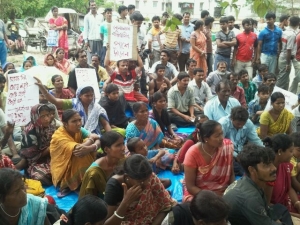
Sit-in by evictees
But this peaceful demonstration was broken by the Kolkata police, who alleged the assembly as ‘illegal’ despite having granted prior permission for the same. 69 protesters of ‘Uchchhed Pratirodh Committee’ (Anti-eviction Committee of Nonadanga) were arrested and transported to Lalbazar police station. A nine-year-old girl child, Manika Kumari, daughter of Dilip Shaw, was in the lock-up for nine hours; Manika Kumari’s detention violated the Juvenile Justice (Care & Protection of Children) Act, which starkly reminds us of Payel Bagh’s case during the Singur unrest. The police deliberately did not, moreover, issue any Memos of Arrest—another violation of legal procedures.

Continuing with the high-handedness, cases under section 151 of the IPC were slapped on the detainees. During the evening of April 8, all the arrested persons were released on PR bond in the presence of members of the Association for the Protection of Democratic Rights (APDR) and other activists through the rear gate of Lalbazar police station. However, seven democratic rights activists were not released and remained in confinement, i.e., Debolina Chakraborty, Shamik Chakraborty, Manas Chatterjee , Debjani Ghosh, Siddhartha Gupta, Partho Sarathi Ray and Abhijnan Sarkar. They have been falsely charged with a number of non-bailable criminal cases. When the released activists and others assembled at Lalbazar became agitated at this unexpected development, all were forced to flee by a huge contingent of aggressive police. APDR members proceeded to the central gate of Lalbazar to speak to the officer in charge and lodged a protest. According to the officers on duty, the seven activists had been charged under various sections including 353, 332, 141, 143, 148 and 149 of the IPC and were to be produced at the Additional Chief Judicial Magistrate (ACJM) court, Alipore, on 9 April, 2012.

The seven activists were remanded to police custody till April 12 by the ACJM court in Alipore Court after the state counsel raised the bogey of Maoist links and alleged that the activists were involved in ‘stockpiling of arms, ammunition and explosives at Nonadanga’. On the same day, a protest rally under the banner of ‘Uchchhed Pratirodh Committee’ (Anti-eviction Committee, a common platform of the evictees of Nonadanga and various mass organizations), demanding rehabilitation for dispossessed people in Nonadanga and release of the arrested protesters was to be held at 1 pm from College Square to Writers’ Building. But police prevented the rally from starting and arrested 50 men, 36 women and 4 children accompanying their mothers. They were taken away by 5 prison vans. The rest of the protesters started sit-in there in College Square, in front of the Vidyasagar statue and a gathering began. Engaging in activities like sloganeering, addressing the local people, etc., the College Street protest continued till 8:30pm, until those 86 arrested men and women were released on bail. The saga of state repression continued on April 10 with APDR activists reporting that the police did not allow family members to meet the seven detained activists. While repression continues in full force, the slum area is also being prepared for the real estate sharks waiting for the people to be “cleared off”. It has been reported that the police undertook a “land survey” on April 10 and declared that they would start fencing off the area from the next day. The evicted slum dwellers, who have living in the nearby fields for the past week, have decided to sit on a hunger strike to protest this move by the authorities.

Meanwhile, friends and supporters of Dr Partho Sarathi Ray have launched a campaign for his release. The following statement gives the details:

Dear Friends,

We are writing to bring to your attention the illegal detention of our colleague, Dr. Partho Sarothi Ray by the Kolkata Police. While participating in a peaceful protest against the eviction of slum dwellers of the Nonadanga area of East Kolkata, Partho along with 68 others including several women and one 9 year old girl was picked up by the Kolkata police near Ruby hospital crossing on Sunday, April 8, 2012. This happened despite the fact that prior permission for carrying out the peaceful protest was granted by the Kolkata police. That same evening, the police released 62 of the 69 people arrested but detained 7 including Partho. Various charges were laid against Partho (and the remaining 6 people detained) for activities allegedly undertaken on April 4 (Wednesday) during which the police resorted to lathi charge on women and children and other brutal tactics to break up a similar protest. Partho was not even present at the site of the protest on April 4 and there is documentary evidence of his presence in IISER, Kolkata (Mohanpur Campus, Nadia, West Bengal) on that day where he participated in a faculty meeting of the Dept. of Biological Sciences, interacted with colleagues and students and stayed overnight at the institute guest house.

Subsequently, during a farcical police court hearing on April 9 held at Alipore court, Kolkata, Partho along with others was remanded to police custody till April 12, 2012. A sessions court on April 12, 2012 remanded the seven detained activists to jail custody until April 26th. Some of the charges laid against Partho and 6 others detained are serious falling under sections 353 (assault on public servant), 332 (voluntarily causing hurt to public servant), 141 (unlawful assembly), 143 (punishment), 149 (common objective of disruption). There is some confusion regarding the number and nature of charges laid since the lists obtained from different sources do not match. In asking for the continued detention of these 7 individuals, the government lawyers made the absurd argument that these people, involved in a peaceful protest for which prior permission was given by the police, had potential Maoist links and it is therefore necessary to keep them in police custody to get “information” about “possible stockpiling of arms and explosives” in Nonadanga. This chilling message reveals the sinister design of the police and the West Bengal government and raises serious concerns for the safety and well-being of Partho and others currently in police
custody. It is therefore essential that we, members of the Indian academic community vociferously condemn the illegal detention of our colleague, a reputed scientist, under false charges and raise awareness so that pressure may be brought on the government to quickly release Partho and remove all the fabricated charges laid against him by the police. Friends in the media can help publicize the issue.

You can also help by signing online petitions here:
Release activists arrested for protesting Nonadanga
www.change.org

Aruna Roy and the MKSS have also sent the following statement in solidarity with Partho Ray and others arrested by the Westy Bengal government:

Dear friends,

An eminent scientist Partha Roy, faculty at IISER Kolkata, an alumnus of IISc and a member of Sanhati, a web paper which reports on democratic and human rights issues, was reporting on a protest against slum clearance in Kolkatta on the 8th of April. He and six others have been booked under sections 143, 149, 332, 341, 342, 353 of the IPC and have been detained unfairly for alleged participation in a protest which took place on the 4th( details in the petition). As it so happened Partha Roy was not there that day, but in the Institute and there is documentary evidence and testimony to prove this.

Despite all this being presented at court he was refused bail by a Kolkata court on the 9th. Intimidation, illegalities and abuse of
power must be questioned and stopped .

In solidarity.
Aruna
Aruna Roy , Nikhil Dey, Shankar Singh and the MKSS

Thursday, April 15, 2010

An Article by Aditya Nigam

http://www.india-seminar.com/2010/607/607_the_problem.htm


THE recent killing of 24 jawans of the Eastern Frontier Rifles in the Silda area of West Midnapore, close to the troubled Maoist-dominated Lalgarh reminds us, as if we needed reminding, of the violent conflict marking parts of our countryside. The gruesome killings of the EFR jawans have been widely condemned, as they should be. The West Bengal state secretary of the CPI(M), Biman Bose, has termed the Maoist operation as a ‘war against democracy.’

From all accounts, the attack was led by an adivasi woman in her thirties – Jagari Baskey – who has been described as a ‘woman with a cobra-like hypnotic gaze.’ As one of the shopkeepers of Silda market told Times of India reporters, ‘(H)er eyes were intense. One look and you knew she meant business.’ There were reportedly other women participating in the operation as well. Jagari Baskey, of course, has already emerged as a mythical figure, her legend relayed through the media. It is difficult to miss the feeling of secret admiration lurking behind the accounts offered by the locals. And so, as one reads through these reports, it is evident that it is an entirely different world out there.

Popular narratives, even when they are opposed to the brutality of the killings, clearly portray that much of the urbane, sophisticated indignation at the killings arises because all we see is the ‘freeze shot’ of a movie that has been on for a long time – a movie where killings, rape, brutality, implication in false police cases and even torture by uniformed agents of the state is a daily affair. It has been a long time since people hereabouts have known peace in their everyday lives. ‘Uniformed brutes’ was probably the only ‘form’ in which they encountered the state. Thus, as one newspaper report put it, it was many years ago that the local adivasis, the Lodhas and the Sabars, first ‘invited’ the ‘forest party’ (bon parti) to come to their area.

They did not invite the ‘bon parti’ to Jangal Mahal because they thought the party would give them development. So, let us get one shibboleth out of the way at the outset. Yes, there is virtually no development – roads, schools, health centres – available to the adivasis of the area. There have even been some starvation deaths in the region in recent years, indicative of the abysmal conditions that obtain. There probably was a time when some basic ‘development’ might have helped. But what seems to have made matters intolerable is not so much the supposed lack of development, but a vicious combination of local power nexuses – forest contractors, the police and the local CPI(M) – which together has so far held the population of the area under its iron grip. And this is what the adivasis are at war against in Lalgarh today. The moment of providing ‘development’, if ever there was any, has clearly passed.

Lalgarh, in that sense, is a typical area of Maoist influence. Yet, while there is sufficient evidence to show that even though the Maoists have been operating in the area for a couple of decades, they were at best a marginal force. It was really the mass uprising against continued police harassment from November 2008 onwards that finally opened the floodgates for them. The situation reached an insurrectionary level only after the electoral defeat of the CPI(M) and the Left Front in May-June 2009 – for this was when the power bloc started showing cracks. And the Maoists stepped into the breach.

In many other areas of Maoist influence as well, there is no difference in at least one thing: alongside the absence of development is the complete impunity with which local power blocs exploit, harass and torture local adivasi populations. This is what provides the Maoist movement its greatest attraction.

Of late, however, something else has happened. If once ‘development’ meant, at the very least, provision of basic amenities to ordinary people, it no longer does, not at least in dominant discourse. Despite tall talk of ‘human development’ and ‘inclusive growth’, progress, particularly economic progress, seems to have been reduced to an obsessive fascination with GDP and the Sensex. And higher growth rates require accelerated and more frenetic exploitation of ‘natural resources’ – forests, mines, land cleared of populations for setting up new steel plants and other industrial projects. In the years since the 1990s, it is this imperative that has been driving our leaders and planners – Capital is the new God and whatever it demands must be provided. If adivasis have to be cleared off their traditional habitats, so be it. In the end, we are told, everything is for the Nation’s development and, of course, what is good for capital is good for the nation. (Remember the old American saying: What’s good for General Motors is good for America?)

It is not simply the ‘lack’ of development but precisely the Thing-Itself, in the way it is conventionally understood, that is the problem. The regions where the Maoists have been in ascendance are precisely the areas where new corporate designs for clearing land are being put in place. And while there indeed are many similar places where non-violent resistance and militant mass struggles have been reported, in areas where there are no mass struggles, ‘Maoism’ certainly begins to look like an attractive option.

How then do we understand this phenomenon called Maoism? As a symptom, maybe? The symptom of a malaise that is slowly and steadily eating away at the body politic. The story of ‘Maoism’ reminds us that there is something seriously wrong somewhere – with our democracy, our justice system and with our priorities of ‘economic growth’.

This issue of Seminar attempts to put together a range of different positions that, hopefully, will help us better understand both the story of Maoism, as well as the other story which runs beneath. There are positions that defend the Maoist movement, as also those that provide a friendly critique; there are positions that present their criticism of the Maoist worldview and praxis head on and others which believe that the symptom – the insurgency – needs treatment (counter-insurgency) as well. Moving away, and beyond, engagements with Maoist theory and worldview are other narratives that map the terrain on which the conflict is taking place.

There is, however, one recurrent problem with taxonomy that needs to be addressed to aid comprehension. ‘Maoism’ is both a genus and a species. As genus, it refers to a whole range of currents that trace their lineage back to the revolt in Naxalbari in 1967. And while most of these currents have adopted some form of a ‘Marxist-Leninist’ tag to describe themselves, it is only two of them (out of the scores that emerged from that burst of ‘spring thunder’) that merged to form the CPI (Maoist). This is the species-Maoism that is under discussion. It may thus help, in order to avoid unnecessary confusion, to use the term ‘Naxalite’ to specifically refer to the genus-Maoism and ‘Maoist’ when referring to the specie.

Far too often, in official parlance, all these terms dissolve into each other – or into that even more nebulous term, left-wing extremism. Such a conflation by the powers-that-be and mainstream media helps thereby to brand all varieties of militant struggle in the countryside as ‘Naxalite’ or ‘Maoist’ or ‘left-wing extremism’, and thus delegitimize them all. Equally, human rights groups questioning the actions of counter-insurgency forces or groups like the Salwa Judum, are far too often derided as Maoist sympathizers. The fact, however, is that most of the Naxalite groups and parties have to varying degrees moved away from the politics of nihilistic armed violence that distinguishes the CPI (Maoist). Tarring them all with the same brush is not merely simplistic – it can be destructive – as it contributes to the endlessly bloated sense of the Maoist’s strength while, at the same time, marginalizing all other tendencies.

Monday, March 8, 2010

Statement on Maoist attack on police camp in West Bengal

Statement on Maoist attack on police camp in West Bengal


We the undersigned would like to express our deep concern at the
ongoing conflict in the Jangalmahal area of West Bengal where forces
of the CPI (Maoist) and the Indian government have been confronting
each other for the past year.

The regular incidents of violence have resulted in the tragic loss of
too many lives already- both of combatants and innocent civilians-
and needs to come to an immediate end. The systematic annihilation of
opponents and the gross violations of human rights by both sides in
the conflict are a serious setback to the task of building a more just
and humane Indian society.

In this context the attack by the CPI (Maoist) cadre on the Silda
police camp in West Bengal on 15 February killing 24 policemen
represents a severe escalation of an already ugly situation in the
Jangalmahal area. Coming at a time when there are active attempts
being made by many sections of civil society to get the Indian
government to call off its proposed ‘Operation Green Hunt’ against the
Maoists this provocative act by the latter can only result in a
hardening of attitudes all around.

While there are many genuine grievances of the local population
against the West Bengal state government and the security forces
operating in the tribal areas of West Midnapore – including arbitrary
arrests and killings- none of them can be used to justify the latest
Maoist action. In fact the purely military methods adopted by the CPI
(Maoist) are inimical to the task of finding both short and long-term
political solutions to the long-standing problems of the local people.

Use of violence for political goals, however lofty, cannot mean
violation of fundamental principles of humanity and there are also
basic norms and conventions that need to be adhered to. Every such
killing and violation adds to the spiral of grief, trauma and revenge
that is already consuming our polity; and from which the common people
desperately need relief.

Monday’s attack on the Silda police camp also represents a
contradiction of the CPI (Maoist)’s own stated position, through media
interviews of its top most leaders, of the need for talks with the
government of India and the prevention of an ‘all out war’. The
massacre of police personnel also shows a lack of seriousness on the
part of the CPI (Maoist) about its own publicly stated demand that for
‘any kind of democratic work, the ban on the Party and Mass
Organizations have to be lifted’.

The Indian State too should immediately stop all its violations of
human rights in the Jangalmahal area, sincerely settle the problems of
the local people and not use the latest Maoist attack as an excuse to
go ahead with further intensification of the conflict.
We the undersigned sincerely hope for a quick and peaceful resolution
to the conflict, which is putting at grave risk the lives of a very
large number of innocent people trapped between the Maoists and the
Indian State.

Prof. A. Marx, Chennai
Bhaskar Vishwanathan, Chennai
Praful Bidwai, New Delhi
Dileep Simeon, New Delhi
Apoorvanand, New Delhi
Aditya Nigam, New Delhi
Nivedita Menon, New Delhi
Amit Sengupta, New Delhi
Satya Sivaraman, New Delhi

Thursday, March 4, 2010

India: Appeal for talks with broader section of people’s struggles in the forest and mineral belt

Aditya Nigam, Dilip Simeon, Jairus Banaji, Nivedita Menon, Rohini Hensman, Satya Sivaraman, Sumit Sarkar, Tanika Sarkar

In the light of the recent demands raised by sections of the intelligentsia urging the government to heed the CPI (Maoist) “offer of talks”, we insist that “civil society” should rather put pressure on the government to initiate talks with representatives of all struggling popular and adivasi organizations. The CPI (Maoist) cannot be treated as the sole spokesperson of all the people in the forest and mineral belt, convenient though this may be for the state and for that party. Does the government believe that violent insurgents are the only deserving interlocutors?

There is a common pattern to the emergence of Maoist violence in many areas. First a non-violent mass organisation like the Peoples Committee Against Police Atrocities (PCAPA) in West Bengal or Chasi Muliya Adivasi Sangh (CMAS) in Orissa arises in response to marginalisation, displacement or violence against tribals by the police and paramilitaries. Then the Maoists step in, attempting to take over the movement and giving it a violent turn. The state responds with even more violence, which is directed not only against the Maoists but also against unaffiliated adivasis. At this point, some adivasis join the Maoists in self-defence, their leaders like Chhatradhar Mahato, Lalmohan Tudu, Singanna are either arrested or gunned down in fake encounters and large numbers of unaffiliated adivasis are branded Maoists or Maoist sympathisers and arrested, killed or terrorised by the state. Clearly, Maoist violence in these cases obtains legitimacy because of the unbridled use of force by security forces and violations of the fundamental rights of the local people. On the other hand, the unilateral and doctrinal use of the language of warfare by one armed group obscures the political agency of the ordinary people who have had no say in this declaration. It also tramples on the human rights of the often desperately poor people who are obliged to seek a livelihood in organisations of the state. Furthermore, it is not clear that the CPI (Maoist) actually shares the rejection of this kind of “development” by the people of the area, or whether it only wants to wrest control of this process from the Indian state.

The counter-insurgency operations mounted by the central government in these areas has led to unprecedented bloodshed, massacres of civilian populations and rampant violations of constitutional rights in the area. The central government insists on treating the affected areas as a “war zone”, and has shown little inclination towards tackling the huge backlog of tribal oppression that has created fertile ground for such violence. It is also true that whenever the government has conceded space, the conditions for this have been created by mass movements, not by the military actions of the CPI (Maoist). For example, the decision by the Ministry of Environment and Forests to put on hold the agreements with Vedanta and Posco in Orissa due to their non-compliance with legal requirements for obtaining the consent of local adivasis, comes in the wake of sustained joint struggles by a range of political groupings.

We therefore urge all democratic sections to put pressure on the government to ensure that:

(1) Regardless of whether talks with the Maoists materialise, talks should immediately be initiated with those adivasis who are losing their land; and with representatives of the various mass-based organisations/mass movements, if necessary by securing their release from prison.

(2) round-the-clock security from attacks by both Maoists and state-sponsored groups and security personnel be provided to these representatives and their families, as well as to witnesses in cases like the Gompad massacre and their families;

(3) the grievances voiced by these representatives be treated with the utmost seriousness and addressed as soon as possible.

Maoist violence flourishes in the fetid atmosphere provided by the destruction of the rule of law and rampant human rights abuses by the state. If the rule of law is ensured in the forest belt and all democratic rights of the adivasis to freedom of association and freedom of expression, including the right of dissent to current “development” policies, are respected, and this dissent taken into account by the government, the Maoists will lose credibility and their deliberate use of violent methods, often designed to invite collateral damage, will lose any basis for flourishing in these areas.


See Also:
http://development-dialogues.blogspot.com/2010/03/government-should-respond-to-maoist.html

Thursday, November 12, 2009

Open Letter to Noam Chomsky: Nirmalangshu Mukherjee

http://kafila.org/2009/10/21/open-letter-to-noam-chomsky-nirmalangshu-mukherjee/

Posted by Aditya Nigam

[We publish below an open letter to Noam Chomsky, written in the wake of his endorsement of a statement against 'Operation Green Hunt', issued recently by a large number of intellectuals in India and in the US. Nirmalangshu's letter is important because it raises some very serious questions that are being brushed under the carpet by sections of the radical intelligentsia. Unlike Nirmalangshu, I would not put 'radical' within scare quotes, since it is precisely this that highlights the immense tragedy of our times. Radical intellectuals - truly radical intellectuals - once again find themselves caught in this situation where in order to oppose state violence, they will wilfully turn a blind eye to the violence of armed nihilist gangs, simply because these claim to speak on behalf of the oppressed - a claim that Nirmalangshu's letter exposes in all its falsity. He lays bare how the politics that goes by the name of 'Maoism' (i.e. CPI-Maoist) believes in violently erasing all other voices of opposition to and criticism of the state, but that of itself. This brand of politics in fact lives in symbiosis with the state - delegitimizing all forms of mass democratic politics. At this moment one deeply misses the courageous voice of the late Balagopal - recently slightingly dubbed a 'liberal humanist' by a spokesperson of the Maoists, at a meeting meant to salute his memory. I cannot help recalling here the feeling of immense sadness many of us were overcome by, watching and hearing speakers at this meeting (in Delhi) for Balagopal - speakers who were ungenerous, if not carping and outright dismissive of the courage of conviction that was Balagopal. AN]

Dear Prof. Chomsky,

I saw your support to the statement issued by Sanhati in the form of a letter to the prime minister— endorsed by some intellectuals from India and abroad. Three points are transparent: (a) the Indian government is planning a massive armed operation in the tribal-hilly areas in the eastern part of the country, (b) the poorest of the poor and the historically marginalised will suffer the most in terms of loss of lives, livelihood and habitat, and (c) for whatever it’s worth, an all-out campaign by democratic forces is needed to resist the armed invasion of people’s habitat by any party. To that extent, the statement does bring out the urgency of the matter.

What is not so transparent from the statement is the condition that has brought about this state of affairs. It is said that large-scale neo-liberal policies—including formation of SEZs and encroachment of tribal habitats for mining and other forms of exploitation—has led to mass impoverishment. So, in desperation, the poor have allegedly taken up arms to defend themselves.

This picture is wrong in (i) ascribing the so-called armed struggle to the people, and (ii) being silent about the ’specific’ source of the current aggression by the state, namely, the armed operations of CPI (Maoist). The statement is otherwise right about the ‘general’ situation: sinister neo-liberal policies, growing impoverishment and marginalisation of the poor, and the resulting anger thereof.

Hundreds of organisations working at the grass roots level across the country are engaged in a variety of struggles against state repression and the insidious economic policies of the government. This includes many Gandhian, liberal and leftist organisations and individuals. Importantly, some of these—such as the organisations led by veteran activists Kanu Sanyal and Asim Chatterjee, among many others in Bengal, Andhra, Bihar, Orissa and elsewhere—also subscribe to maoism and are known initiators of the original naxalbari movement. Thus, the labels ‘maoist’ and ‘naxalite’ apply to a much wider category of organisations and individuals than the CPI (Maoist). Needless to say, even the wider category of maoists, not to mention just the CPI (Maoist), forms a tiny fraction of the broad democratic resistance to the policies of the state. The current armed operations of the state are directed ostensibly against the CPI (Maoist) in the areas under its control.

The state of course makes no such distinction in public; by identifying the wider category with the narrower one, it is constructing the opportunity to target the entire left-democratic fraternity in due course. To put the point differently, although the undeclared target of the state covers the entirety of left-democratic forces—as evidenced, for example, in the growing attacks on industrial workers especially in the private sector—the declared target currently consists of CPI (Maoist) and its area of control. The significance of this specificity is wholly missing from the statement you endorsed.

The identification of CPI (Maoist) with the entire resistance movement suits CPI (Maoist) as well. Its Supreme Commander recently declared from his hideout from a guerrilla-controlled area: ‘People, who are the makers of history, will rise up like a tornado under “our party’s leadership” to wipe out the reactionary blood-sucking vampires ruling our country … our party’s influence has grown stronger and “it” has now come to be recognised as the only genuine alternative before the people.’ (Open magazine). We will evaluate the factual content of this declaration below.

For now, it is interesting to note the character of the propaganda: somehow the propagandist interests of CPI (Maoist), the state, and the corporate media suitably converge. The Supreme Commander’s claim is grimly endorsed by the prime and the home ministers of India; according to them, the ‘naxalite menace’ is the greatest threat to internal security. It is also endorsed by the corporate media: the ‘menace’ is said to have spread in 15 of about 25 states, and in 180 of about 500 districts of the country—the numbers accelerating each month to encourage the prospect of a ‘civil war’ soon across the country. The Central government frequently convenes high-profile meetings of chief ministers, secretaries, and police chiefs of the country to meet the challenges posed by the menace. Cutting-edge special forces, carved out of the paramilitary forces, are being constructed and deployed in ‘naxal-infested’ areas. In recent months, even the army and the air force are beginning to enter into the picture. Naxalite actions—widespread arson, mass killings, and the ability to take on the security forces—are prominently reported in the corporate media with ill-concealed awe. This strand of the naxalite movement never had it so big in its close to 40 years of existence in hideouts in remote jungles.

As for the factual content of this dramatic story, I will briefly record some facts that do not find a place in the three-pronged propaganda.

- CPI (Maoist) is a comparatively new organisation formed in 2004 when two naxalite factions Maoist Coordination Committee (MCC) and People’s War Group (PWG)—located primarily in some tribal-inhabited jungle areas in Bihar and Andhra Pradesh respectively—decided to join hands after fighting a bloody war for area-control among themselves for close to two decades. By 2006, CPI (Maoist) was almost completely wiped out from Andhra after their presence there for close to forty years. They also lost major areas in Bihar. The organisation has basically shifted to two of the most backward, tiny, and newly-formed states of Jharkhand and Chatthisgarh. As noted, even there, their presence is basically centered in the areas of dense forest and adjacent tribal-dominated villages, especially in the Bastar district. Ostensibly, as the jungles extend from their headquarters, they have also developed some hideouts and some armed squads to create enough violence to mark their ‘presence’ in West Bengal, Orissa, and elsewhere. To sum, they have essentially failed to emerge out of portions of jungles of eastern India after over four decades of campaign for this particular strand of ‘Marxism-Leninism-Maoism’.

- The organisation has no presence whatsoever in the vast agrarian and industrial terrains of the rest of the country. It has no trade union, no peasant organisation worth its name, no penetration in the dalit, youth, and women’s movements. But it seems to have captured the imagination of sections of elite, urban, and ‘radical’ intelligentsia in Calcutta and Delhi who have impressive connections with some Indian intellectuals settled in universities abroad, as the statement you endorsed highlights (earlier, this intellectual support used to come from Bombay and Hyderabad). The phenomenon is historically familiar.

- ‘The only genuine alternative before the people’ is viewed as a terrorist organisation by none other than Kanu Sanyal and many other active maoists, not to speak of broad spectrums of left parties and organisations most of whom do not find a representation in the statement. The basic reason why Sanyal calls CPI (Maoist) ‘terrorists’ is as follows.

Ever since its inception in 1969, this brand of maoism rejected all classical forms of mass struggle and adopted the sinister doctrine of individual annihilation of ‘class enemies’. ‘Class enemies’ typically consisted of hapless, poorly armed police constables, petty landlords and traders, and an assorted category of ‘informers and traitors’. Most notably, the category of ‘class enemies’ also included grass-root cadres—not their leaders—of the parliamentary left. In the states of West Bengal and Andhra, where this campaign originated, the parliamentary left was typically the only organisation present at the grass root. The annihilation of these ‘class enemies’—typically, middle peasants, school teachers, party wholetimers, etc—effectively meant capturing of areas, by means of guns and knives, already under the left. To that end, the squads first targetted their own maoist fraternity who refused to subscribe to their murderous politics. After the ‘renegades’ were silenced, the next target was cadres of CPI(M), CPI, etc.

This ‘red terror’ basically led to the dismantling of democratic movements in the erstwhile red bastions. In West Bengal, a neo-fascist regime of the Congress Party won the elections handsomely and watched the mutual killings of the left with glee. Once the task was accomplished, the government turned on the maoists and the remaining left and white terror ruled West Bengal for five years. During the nightmare, all forms of democratic movements virtually disappeared from the state as lumpen youth accompanied by paramilitary forces roamed the streets.

In time, almost all of the initiators of this campaign realised their grave mistakes and those who survived encounters, long imprisonment, and psychological collapse, returned to classical mass lines in a variety of forms, including participation in the elections. However, a fragment continued the murderous politics in the jungles of Andhra and Bihar in the form of two organisations MCC and PWG, later unifying into CPI (Maoist), as noted.

Two recent—and contrasting—events in the neighbourhood throw significant light on the consequences of this brand of politics. In Sri Lanka, a vast freedom movement of Tamil nationalism arose about three decades ago. As the movement became progressively militant, it gave rise to a formidable militarist organisation: Liberation Tigers of Tamil Elam (LTTE). LTTE declared armed struggle, systematically eliminated all other groups advocating Tamil liberation, took to the jungles, and launched a civil war.

There were several rounds of ‘negotiations’ between the government and the LTTE, often with international effort. LTTE refused to give up arms and join the democratic process; thus, it used each pause in the hostilities to consolidate its forces. After over twenty years of bloody war with Sri Lankan security forces, resulting in incalculable suffering of Tamil people, the LTTE was recently wiped out from Sri Lanka. The calamity facilitated the emergence of a neo-fascist regime in Colombo; it also left behind nearly a million hapless Tamil refugees at the mercy of this government. With all moderate forces from both the sides eliminated from the scene, the Tamil freedom movement is now faced with a historical setback after over hundred thousand deaths.

The Supreme Commander (cited above), whose organisation was trained in guerrilla warfare by former commandos of LTTE, agrees with the consequences: ‘There is no doubt that the movement for a separate sovereign Tamil Eelam has suffered a severe setback with the defeat and considerable decimation of the LTTE. The Tamil people and the national liberation forces are now leaderless.’ But he puts the blame elsewhere: ‘The jingoistic rallies and celebrations organised by the government and Sinhala chauvinist parties all over Sri Lanka in the wake of Prabhakaran’s death and the defeat of the LTTE show the national hatred for Tamils nurtured by Sinhala organisations and the extent to which the minds of ordinary Sinhalese are poisoned with such chauvinist frenzy.’ Nonetheless, he hopes that ‘the ground remains fertile for the resurgence of the Tamil liberation struggle. Even if it takes time, the war for a separate Tamil Eelam is certain to revive, taking lessons from the defeat of the LTTE.’ Although he is prepared to learn—perhaps, tactical—‘lessons’, he does not seem to have any problems with the militarist, sectarian, and exclusivist politics of the LTTE.

In sharp contrast, the Communist Party of Nepal (Maoist) (CPN(M)) also launched a civil war against a ruthless feudal monarchy protected by the Royal Nepalese Army after all democratic methods failed. The war lasted nearly a decade with the CPN(M)-directed People’s Liberation Army dominating vast terrains of the country with massive popular support. The basic point to note is that what CPN(M) strove for during the armed struggle—republic, constituent assembly, supremacy of the parliament created by universal franchise, etc.—India already has. Once that was achieved in Nepal, a genuine armed struggle—far far superior than anything Indian ‘maoists’ have ever envisaged—was immediately brought to a halt. CPN (M) proved its point by winning over 40% of the seats in the interim parliament after the republic was established. With this mandate in hand, innovative, peaceful but militant processes were then adopted to broaden the democratic base even in a context in which the possibility of a counter-revolution orchestrated by the ousted monarch, the army and the ruling elites of India loomed large.

The current impasse in Nepal is about the supremacy of the parliament over the army. As the leader of CPN(M) Prachanda points out, the democratic movement is at a crossroads due to this seminal conflict. Indian republicanism addressed and solved that problem 60 years ago.

During the war, PWG—followed by CPI (Maoist)—maintained close contact with CPN(M). But after the CPN(M) joined—in fact, established—the democratic process in Nepal, the CPI (Maoist) does not find any lessons to be learned. This time the blame is on CPN(M). As the Supreme Commander puts it: ‘It is indeed a great tragedy that the CPN(M) has chosen to abandon the path of protracted people’s war and pursue a parliamentary path in spite of having de facto power in most of the countryside.’ In a letter to CPN(M), CPI (Maoist) ‘advised’ the former not to give up armed struggle until the ‘old order’ is smashed and the CPN (M) is able to seize power all by itself to usher in ‘new democratic revolution’. However, the Supreme Commander remains optimistic since ‘given the great revolutionary traditions of the CPN(M), we hope that the inner-party struggle will repudiate the right opportunist line pursued by its leadership, give up revisionist stands and practices, and apply minds creatively to the concrete conditions of Nepal.’ So, the statesman-like leadership of Prachanda is ‘revisionist’.

Beyond the bluster, it is not difficult to discern that, no matter what, the CPI (Maoist) is not prepared to give up its fatal policies. They are not open to any debates, no one can enter their ‘liberated zones’ without unconditional support to their line. Like Prabhakaran and his LTTE, having meticulously secured hideouts for themselves in ‘impregnable’ dense forests protected by squads armed with sophisticated weapons, they are prepared to carry on ‘protracted war’ for many years before their inevitable decimation. In the process, not only will the tribals under their control suffer immensely, it will give the growingly authoritarian state a golden opportunity to smash whatever avenues of hard-won democratic resistance still remain in place.

As noted, the CPI (Maoist) has exactly two channels of ‘popular’ support: the tribals they control and a section of ‘radical’, urban intelligentsia. It is the support of the latter that gives the CPI (Maoist) significant propaganda mileage and a false impression of invincibility and popular support. By posing the current military preparations of the state only as a state vs. people conflict, the statement you endorsed effectively exonerates the CPI (Maoist) and plays into their hands.

Sincerely

Nirmalangshu Mukherji
Department of Philosopy
University of Delhi

See Also:

http://development-dialogues.blogspot.com/2009/11/operation-green-hunt-who-is-state.html

Monday, June 30, 2008

The poor poetry of industrialisation

http://www.himalmag.com/2007/february/opinion1.htm


The Communist Party of India (Marxist) in wonderland.

by | Aditya Nigam


bilash rai

The West Bengal Chief Minister and the ruling Left Front (LF) government’s former poet-commissar, Buddhadeb Bhattacharya, translator of Mayakovsky, is busy with another kind of poetry these days. He is transposing the ‘poetry’ of industrialisation – as it happened on the soil of England – onto the land called Bengal. Dazzled by the dreamworld of capital, Buddhadeb has been quick to shake off the shackles of his earlier convictions and seek aesthetic pleasure in his new role as the ‘Commissar of Industry and Progress’. For quite some time now, Bhattacharya has been trying to convince prospective investors to take the leftists at their word when they say they really are in favour of neo-liberal reforms: “We are realists and we know it’s either reform or perish.” Progress, he understands, entails the death of all that is archaic – revolutionary convictions and agriculture, for instance.

Rapid industrialisation is the only way forward, and Special Economic Zones (SEZs) are the quickest way to industrialise. The idea of SEZs has been directly imported into India – and indeed into West Bengal – from China, and from the neo-liberal’s point of view, such units are the important first step in the direction of the brave new world of capital. Eventually, these enthusiasts intend to extend to the entire country the facilities enjoyed by SEZs – tax holidays, exemption from labour laws, unrestricted import facilities, cheap land taken over from Adivasis and peasants, and the freedom of unrestrained exploitation of natural resources.

China is Bhattacharya’s immediate inspiration and justification; but alas, unlike in China, he has a democracy to deal with. The process of industrialisation that Bhattacharya and his party, the CPI(M), have initiated would be every bit as ruthless and violent as it is in China – but for this fact of democracy, which allows the peasants to manifest their resistance.

Thus it happened that on 1 December 2006, several thousand police and paramilitary troops descended on a small and obscure place, the name of which very few outside the state of West Bengal had heard of: Singur. They came to fence off an area of 997 acres of prime agricultural land in Hooghly District so that it could be handed over to the Tata conglomerate, who would establish on it a plant for the manufacture of cheap cars.

What happened in Singur revealed in a flash to all of rural Bengal the plan for the much advertised industrialisation programme: The peasants would be dispossessed at any cost to clear the way. The police fired teargas and rubber bullets at the protesting villagers. They were beaten up and their paddy harvests set on fire. For the peasants did not give up their land voluntarily.

The anger among the local population has been building up ever since the news of the Tatas’ plans for the factory reached Singur in May 2006, even as the newly-elected Left Front government was taking oath. As mass discontent became apparent, various smaller leftwing organisations, especially Naxalite groups and intellectuals, started becoming involved. The involvement of Medha Patkar, leader of the Narmada Bachao Andolan (NBA) and the National Alliance of Peoples’ Movements (NAPM), helped draw attention to the issue, while the active championing of the cause of the peasants and sharecroppers by the Trinamool Congress leader Mamata Banerjee brought in the dimension of electoral calculus.

Weak wicket
The Bhattacharya government has been claiming that the acquisition process has been transparent and democratic, and that of the 997 acres required for the project, the consent of the owners had already been acquired for 952 acres by December. These owners – so claimed the LF government and the CPI(M) leader Brinda Karat – had not only given their consent, but were enthusiastically queuing up for the attractive cash compensation package. In a show that smacked of manipulation, the CPI(M) even got these villagers to set up an organisation to “support industrialisation”. Revealingly – and a trifle farcically – it was called ‘Pragatisheel Swechchha Jomi Bikreta, Shilpa Sthapan O Shahar Unnayan Committee (Committee of Progressive, Voluntary Land-Sellers, Supporters of Industrialisation and City Development)’. These people were apparently dying to give up their land at prices far below the market rate for the noble cause of industrialisation! Be the case of the ‘land-seller’ as it may, what about the animal called the sharecropper? What about the people who work the land but do not own it? What about those for whom the CPI(M) had in the early 1980s devised the well-known ‘Operation Barga’, to protect their tenure by means of registration? By the time Singur happened, however, the landless peasant/sharecropper had all but disappeared from CPI(M)’s horizon. When cornered, the party’s leaders said they had ensured that the landless would be given jobs in the factory. Given that all labour laws are null and void within an SEZ, it was left unclear how CPI(M) would ensure that the job guarantee would be affected.

Critics have pointed out that even government statistics show 333,372 hectares of fallow and 119,146 hectares of uncultivable land available in West Bengal, in addition to over 40,000 acres of land locked in mills and factories no longer functioning, which could be used for the purpose of setting up a new factory. Amitdyuti Kumar, vice-president of the Association for the Protection of Democratic Rights (APDR), also refers to a memorandum submitted by the CPI(M) MP Santasri Chatterjee, president of the Hooghly District chapter of the Centre of Indian Trade Unions, to the local district magistrate, demanding use of such premises for the establishment of new industrial units.

Interestingly, Chatterjee’s memorandum also states that the Birlas were given 744 acres in 1948 in order to set up Hind Motors in the district, but that they only used 252 acres – 500 acres had remained unused for 58 years. Critics argue that automobile factories, including the Tatas’ own, do not need such large parcels of land. They also point out that, even by Tata Motors’ estimates, there is no way the project will generate more than 2000 jobs. Yet the number of people losing livelihoods, including sharecroppers, is likely to be in the region of 15,000.

The government’s claim that the Singur land is good only for single-crop cultivation, or that it is wasteland, has also been shown to be false. Most of the land concerned is fertile multi-crop land, and the government’s claims on the matter seem to be based on land records that have not been updated for decades. Noted leftwing historian Sumit Sarkar recently affirmed, after a visit to Singur, that most of the government’s claims are indeed highly questionable: neither was the process of acquisition democratic and transparent, nor was the claim that the land was single-crop correct.

Outsiders, insiders
Singur was still creating a stir when a major eruption occurred in the Nandigram area of East Midnapore District. Here, in early January, the villagers were up in arms, as news reached them of an order by the Haldia Development Authority, under which Nandigram falls, identifying land for acquisition in the preparation of two new SEZs in the area. One of these is to be set up by the Salim Group, an Indonesian multinational corporation that was at the centre of much controversy last year, as Buddhadeb had committed it 5000 acres of land without consultation with other government functionaries. The drastic amendments he proposed to existing laws in order to facilitate these acquisitions, however, were rejected by a unanimous vote of the state assembly.

The two SEZs in the Haldia area will involve much more land than did the Tatas’ venture – somewhat over 14,500 acres to begin with. As the leaked news reached Nandigram, panic set in and preparations were made on a war footing for the possible arrival of police and paramilitary forces, to implement the land acquisition. The rage of the population fell on the local CPI(M) cadres, who had to flee for their lives. An angry crowd also set the local party office on fire and put up roadblocks in the approaches to the village. Sumit Sarkar’s report on Singur laments that the word cadre has become a term of abuse in local parlance. The party’s response to this outburst was to mobilise more ‘cadres’ from neighbouring areas and to launch a pre-meditated counterattack in which at least six people were killed.

In the course of its troubles in Singur and Nandigram, the CPI(M) leadership needed a scapegoat by means of which to discredit the struggle against its policies. They found this in the figure of the ‘outsider’, a representation that encompasses anyone who is not directly affected by the land acquisitions. The outsider could be Medha Patkar, the local Naxalite activist, students or intellectuals from Calcutta, or even local activists of parties such as the Trinamool Congress and the Socialist Unity Centre of India (SUCI). This is a strange argument for the communists to make, given that not one of their unions in any factory could have been set up without the active support of people from ‘outside’. But more to the point, might one be pardoned for asking, Are the Tatas and the Salim group of industries ‘insiders’? Is Buddha Babu, who committed other people’s land to these companies against the will of the owners, an insider?

Though there is an apparent calm for the time being, the West Bengal countryside is simmering, and much will depend on whether Mr Bhattacharya and the CPI(M) are prepared to rethink their strategy of rapid industrialisation. Agriculture in its present form might not be the best option, but if the rationale behind industrialisation is that it will create more jobs, it is clearly misplaced. Does Buddha Babu have any other strategy in mind, and will he act on it before irreversible damage is done?

Monday, November 12, 2007

Time for Alternative Left Platform in W Bengal

Source:

http://www.kafila.org/2007/11/11/time-for-alternative-left-platform-in-w-bengal/

Aditya Nigam


The CPM mask is off. Beneath it you can see the face of the totalitarian face of the Biman Boses, Benoy Konars and Brinda Karats. Much more is to come in coming days but one thing seems to be becoming clearer with each passing day: it will be wrong now on, to count the CPM as a Left wing force (at least in West Bengal). Unless we are able to shed this misleading idea, we are likely to misread the situation in the state completely.

The situation in Nandigram is developing rapidly. The area has been ‘liberated’ - which is to say brought under CPM control. Nobody, including journalists and political and civil rights activitsts can enter the area. All you have are marauding criminal gangs of AK 47 (and other assorted weapon) wielding ‘cadres’. They roam about with the red flag and have no compunction in attacking the likes of Medha Patkar and Anuradha Talwar, punching them in the face and tearing at their clothes. This is a political style and culture that we have so far only associated with the fascist right. We have seen glimpses of it in the recent past in the state but now it has assumed a generalized form. And while the armed gangs are at work in Nandigram, the state’s police has started targetting protestors in Kolkata.

Thus, even as Medha Patkar’s hunger strike continued in Kolkata, a march of artistes and intellectuals was stopped as they were walking towards Nandan, the venue of the Kolkata Film Festival. Forty of these intellectuals were arrested under section 151, (apprehension of breach of peace). The situation has reached such a pass, that the LF government is finding it difficult to even face such simple and harmless shows of protest by artistes and intellectuals; after all nobody including the CPM can really believe that these artistes posed any threat to ‘law and order’ or ‘peace’. In fact, for the first time in its history, three important Left Front partners, the RSP, Forward Bloc and the CPI, have come out openly against the CPM, holding it alone responsible for the violence.
The time has indeed come for them to now quit the LF and help in the formation of an alternative Left platform in the state. For, this might be the beginning of the end of LF rule in the state - and if the entire discontent against the CPM is not to be mobilized under a Trinamool Congress type opposition, then it is imperative that efforts be stepped up to present and alternative, democratic Left opposition.

But in the meantime, it is necessary to ask, what exactly is happening in Nandigram? The story that has been dished out over the past nine months - repeated with nauseating regularity by the illiterates in the televisual media - that it is a CPM-Trinamool Congress turf war, is, to say the least, completely off the mark. More, it is deliberately misleading. It is a line that suits the CPM ruling circles no doubt, but it is also something that the news media, drunk on its globalization potion, likes to believe. It like to believe that if only there were no political parties, everything would be hunky dory for the neo-liberal globalizers. It is only ‘politics’ which is holding back the rapid pace of India’s development. ‘Politics’ (which should, as far as the globalization-drunk media lingo is concerned, be read as ‘democracy’) is the the real road block. And here, Buddhadeb’s type of Left-wing capitalism was something they would have rather liked to see. It has unfortunately gone beyond all limits, even for the media to defend.

Let us be clear about one thing: Buddhadeb’s and CPM’s socalled ‘assurances’ that the SEZ and the chemical hub will not be built in Nandigram, that its project has been abandoned, do not mean anything anymore. In the first place nobody trusts him or his party anymore. More importantly, the issue is not whether the SEZ will be made; it is a battle for suzerainty being conducted by the CPM. It is not that CPM supporters could not have returned to their homes in the last few months. But the CPM wanted to come back as rulers, with the area fully under their control. That is where the problem lies. Since large sections of the population have ceased to trust the government and the CPM, the people of the area are suspicious of its intent. The posture of innocence often struck by CPM leaders and supporters that “after all we have said that there will be no chemical hub” is disingenuous, to say the least.

Let us therefore, also be clear about another thing: There is popular discontent in the region and the people have turned to the only available anti-CPM (anti- establishment) forces in the area, which include the Jamiat-e-Ulema-e-Hind, the TMC and the Maoists. Just as popular discontent in the state had once turned to the CPM against the ruling Congress, it is now turning against it. Then, in the sixties, during the food movement and later the land struggles, the CPM also made alliances in the United Front with parties like the Bangla Congress and other assorted groups. In other places, the CPM has made common cause with the Jana Sangh/ BJP (the
anti-Emergency struggle, the 1989 elections etc). [In Kerala, even without any mass struggle, the CPM has long had alliances (often legitimately) with the Muslim League.] So, for it to suddenly take this holier-than-thou attitude and dub the Nandigram struggle as a ‘Trinamool- Maoist’-combine-led ‘disturbance’ is not only dishonest, it in fact speaks of a fundamental change in the party’s role and self-perception. From a party of struggle, it has become a party of order and government.

And while this completely illegal and unconstitutional violence is perpetrated on the hapless people of Nandigram, the CPM state leadership and the Polit Bureau have found fault with governor Gopal Gandhi for ‘overstepping his constitutional limits’. Interesting, to say the least. Let the CPM know, that for an increasingly large number of people in the state, it is Gandhi who is becoming the voice of sanity. It is to him that former Chief Justice Krishna Iyer appealed; it is to him that all intellectuals and concerned citizens elsewhere in India
are appealing. It is also to Gandhi that the intellectuals in the state are looking up to for restoring constitutional order. Blinded by its arrogance of power, the CPM refuses to see the writing on the wall - but for how long. Now power, however despotic has lasted for ever. How can this one?

Wednesday, July 4, 2007

‘Scientific’ Land Grab and the Lie-Machine

Source:
http://www.kafila.org/2007/01/10/%e2%80%98scientific%e2%80%99-land-grab-and-the-lie-machine/

By Aditya Nigam

Even as the CPM general secretary Prakash Karat made his astonishing statement regarding the need for a ‘scientific’ land grab policy, his party’s totalitarian lie machine has moved into action to suppress the fact that it might be facing its Waterloo – or may we say, its Stalingrad? The lie manufacturing machine is working overtime to make it appear as though the struggle in Nandigram over the imminent acquisition of 14, 500 acres of land for a new SEZ is the outcome of mere ‘rumour mongering’ by ‘outsiders’ (The Hindu 9 January 2007). It is as though there were really no plans to that effect (though none of the leaders has yet denied this so far).

One of the sinister players here is the shadowy West Bengal CPM secretary and Left Front Chairman (sic), Biman Basu. Basu went on record saying that (a) a large number of ‘outsiders’ have been entering Nandigram [and this presumably is by itself a crime, in Basu’s language] and that the police should thus ‘investigate’ it. (b) these outsiders were “responsible for stoking fears among local villagers that they were on the verge of losing their land.” To give it a more sinister ring, Basu said: “ These people are still moving about in the Nandigram area [as though they are criminals who should have been put behind bars] and held periodic meetings at a four-storied building where social activist Medha Patkar addressed a meeting on December 3.”

These outsiders, Biman Basu goes on to say, came “from Bihar, Orissa and even Kolkata [!!] and are holding clandestine meetings.” This statement itself calls for a deep analysis – for that alone might reveal the psychic structure of the fear that Basu seeks to whip up (and is himself constituted by), playing on a host of different kinds of elements – the Other, the outsider, the ‘Maoist’, the terrorist, the criminal – that are invoked by totalitarian lie manufacturing machines all the time. Remember that using the presence of the Jamait-ul-Ulema-e-Hind in this area with a large Muslim population, the CPM machine has already raised the communal bogey, directly resorting to the most time-tested of methods of most hated oppressors. However, just by way of a minor clarification, we might draw attention to the fact that the entire ‘scare’ – if that be the name for what people who were on the verge of losing their land felt – was created by the order of the Chief Executive Officer, Haldia Development Authority, dated 28 December 2006. Rumours, would you say, Mr Basu? Yes, the interesting and important fact is that this order that was meant to be kept secret till the party machine had already terrorized the prospective land losers and the state machinery was prepared – scientifically – to move in with armed forces. Unfortunately for the CPM, it was leaked. More likely, the CEO of the HDA himself acted in haste; he should have waited for further order before issuing his orders.

The other dramatis personae in this story include the Krishak Sabha leader Benoy Konar (brother of the legendary Harekrishna Konar) and the local Tamluk Member of Parliament, Lakshman Seth, who incidentally chairs the HDA. As the fear of land acquisitions spread and the local people prepared to fight it out, clashes erupted, the exact sequence of events of which has yet to be reconstructed. One thing is clear: the CPM was taken by surprise and this was simply because it had not anticipated the leak and the anger it would generate. Let us be clear about one thing here. Nowhere in rural West Bengal is the CPM in a position of being hounded by any political party – least of all the Trinamool Congress – as was being suggested by the state CPM leadership, for it is the CPM that constitutes the power bloc at the local level. It was an unexpected mass anger that took it completely by surprise that the party had to reckon with. It was from its own people that it was forced to flee and take refuge in camps. It was not a clash between the CPM on the one hand and the TC and Jamait and the Naxalite groups and SUCI on the other. In fact, the reason why all these disparate forces are having to make common cause is because they are dealing with popular discontent. And what did the party do, faced with this situation? They took a day to recover, whereafter, Benoy Konar declared that the CPM would call for “armed retaliation if the Opposition’s terror campaign continues.” Bijon Roy, secretary of the Haldia Zonal Committee of the CPM assured the local activists, before departing foe a ZC meeting on Friday (5 January) evening that ‘necessary action” would be taken. Reportedly, in the ZC meeting, Lakshman Seth said that “the party’s morale must be boosted at any cost.” District secretariat member Ashok Guria was even more candid as he spoke to The Telegraph, a paper that has become the CPM’s most loyal supporter: “We realized it was of utmost importance to boost the flagging morale of the party workers. So we brought over our comrades from Khejuri and other places.” So reports Naresh Jana of The Telegraph, “The mobilization began on Friday night. Activists, mostly from Khejuri poured into Tekhali, Bhangabera, Sherkhachak, Kurighat, Bangshubazar, CPM strongholds on the fringes of Nandigram.” Further: “they came in Matador vans, on motorcycles, bicycles and on foot. By Saturday there were about 250 of them in each of these five centers.” On Saturday night the clashes began. Through Sunday the clashes continued. Need we say more about how the killings of that day might have taken place? It was necessary in this situation that the incidents of the earlier days be presented as a mere fight between opposing parties – a version that some sections of the press seem to have swallowed.

Meanwhile, Buddhadev Bhattacharya, chief minister and key player of the industrialization story, is at least more forthright, having accepted before television channels on the day of the Nandigram killings that “‘our’ past mistakes are responsible for this situation.” The mistake, according to him, is that ‘we’ ‘invented’ this style of politics, “we invented the word ‘gherao’”. There couldn’t be a more candid self realization – a public recognition that he and his party have changed sides. Perhaps, he might remember that there was a time when he, Biman or Benoy Konar went around from district to district (as understudies of the older generation of leaders) – often holding clandestine meetings in villages, stoking fires of revolt. Except that he is wrong to say that ‘we’ invented this politics: neither he nor his party did. This has ever been the method available to powerless groups in revolt through the ages – whenever power becomes despotic, that is.

Responses to “‘Scientific’ Land Grab and the Lie-Machine”


  1. Rajesh Jan 11th, 2007 at 2:53 am

    After spreading the canard that the entire unrest in Nandigram was on the basis of `rumours’ of land acquisition spread by `vested interests’, the West Bengal CM has backtracked and admitted that the Haldia Development Authority did issue a notification identifying some mouzas as sites for an SEZ in Nandigram, `without government sanction’.

    Meanwhile the Central Committee of the CPI(M), in its latest statement, holds on to the outdated rumour that no notice was issued for land acquisition, technically correct of course, since the HDA notification only identified mouzas without government sanction. With this, the CPM CC wishes to warn `well-meaning individuals’- Romila Thapar, Sumit Sarkar, Rajindar Sachar, Arundhati Roy etc., please note – that they may be falling prey to `disinformation’ by `vested interests’. In the CC’s view, it appears that peasants in Medinipur or Singur, or intellectuals in Delhi, have no minds of their own, and are always ready to be mislead by rumours and disinformation spread by `outsiders’.

    Yesterday, the historian Sumit Sarkar, son of the late Marxist historian Sushobhan Sarkar, and himself “a lifelong Leftist” wrote of his trip to Singur (posted on forestrights yesterday). What he discovered directly contradicts the version of Singur published by Brinda Karat in The Hindu, ironically titled “Just the Facts, Please”. Medha Patkar had earlier pointed out that Brinda Karat had got all her `facts’ about Singur from a visit to Kolkata.

    Special mention must be made of The Hindu group of publications, which sometimes read like the alternative mouthpiece of the CPI(M), especially when the by-lines read Marcus Dam (The Hindu), or Suhrid Shankar Chattopadhyay or R. Krishnakumar (Frontline). The venerable Editir-in-Chief also pitches in. A New Year’s day full-page editorial on Singur (http://www.hindu.com/2007/01/01/stories/2007010102541000.htm) drew on the same “key facts” and “context” that Brinda Karat was privy to and presented a blatantly partisan picture. Frontline did the same with the same set of `facts’ and hackneyed arguments about the imperative of industrialisation, prophetically titling the piece “Starting Trouble”, and inexplicably prefacing it with a quote attributed to Lenin- “You cannot make an omelette without breaking some eggs”. (http://www.frontlineonnet.com/fl2325/stories/20061229002003300.htm)
    Several broken eggs later, one wonders what the omelette will taste like, if it eventually gets made.

  2. Aditya Nigam Jan 12th, 2007 at 3:30 am

    Rajesh: Thanks for filling in on the parts I did not cover. And of course, I also completely agree with your take on this Hindu/Frontline business. Mouthpieces of the CPM, without doubt and equally guilty of twisting facts. A mirror-image of the Indian Express, I would say, as far as covering the CPM is concerned. Apoplexy: Really enjoyed reading your blog and the pictures on Nandigram.

  3. Apoplexy Jan 13th, 2007 at 5:39 pm

    Thanks.If you read the blog more. there is a successive civerage of Singur and even before the CPM/sfi violence against left wing student protestors in Calcutta.11 of my friends were taken into custody for protesting against CPM in Calcutta.Today 4 were picked up from a cultural center more moving about “suspiciously”.Leftists and freedom and democracy lovers at all levels must speak out against CPM totalitarianism, as well as expose Congress/BJP likes forces which have even more demonical records.
    Just wondering, what do you do?

  4. Rajesh Jan 14th, 2007 at 10:38 pm

    More on the reportage of The Hindu at

    Singur: The Emperors Have No Clothes
    January 12, 2007
    http://desicritics.org/2007/01/12/053321.php

    Rajesh

  5. Alok Mar 15th, 2007 at 2:37 am

    Politics in West Bengal is going for a toss. The so called ruling party CPM is just doing things which are anti-villagers and th every root of them is being at stake.Blocking the roads and media and then piggybacking on forces like state police etc. is completely a sheer sign of frustration. Though it won state elections with thumping majority but their act shows no sense party’s look. The kills which involved women and children in Nandigram was a utter shock to me, the high-handedness of CPM workers and the utilization of police to settle scores with Villagers,shouting that outsiders are howering Nandigram and so, is a cowardly act.Their act is reminding me of the British era in India, we are a Democratic country and every person has his/her right to decide what way he wants to do with his/her property and when its fertile tilling Land, then Govt. shouldn’t drag things into this sort where innocent mob is shot by none but the elected ruling party.It’s high time that Centre Govt. teach this ruling party a lesson or two and book culprits under the court of law. Bhudhhadeb is not the type of person that he pretends to be (definetly not an intellectual), and behaving like a Mad Dog bitten by power, greed and proud not of his countrymen but his own thoughtness, which is blank.

  6. s22.7 Mar 16th, 2007 at 1:39 am

    singured and nandigrammed
    this i think is the beginning of revolution in india. i really appreciate the courage with which young boys and girls face police brutality. they cannot do this without any conviction which i am sure springs from their ideological commitment. i have seen the SUCI activists give life for a cause they believe is genuine. if not who would fight like that for the reintroduction of English? The cpim is so helpless that it thinks physical annihilation. death can kill a body not an ideology. it will inspire many more. including teh cpim cadres who are now moving over to teh BUPC to resist theland grab

  7. Sohini Mookherjea Mar 19th, 2007 at 5:24 am

    Today’s Economic Times carries an article in Kolkata edition in the political theatre section titled Landing beyond Lakshman rekha and this is how the piece ends

    “Kolkata was 135 kms away and we were intent on crossing this distance before dusk settled in. With all vehicles under attack, especially Press cars, there was no way you could see where the next hurled brick was going to land. Fun afterall.”

    please note the last two words…thought the usage was quite unwarranted…and shows complete lack of sensitivity…are we not writing on the loss of human lives and on such a scale and given the circumstances…or any circumstances for that matter which deserve more respect…

    for the whole story one could visit this link…
    http://economictimes.indiatimes.com/articleshow/1779942.cms?epaper

Thursday, May 3, 2007

Analysis of the Statement Issued by the Left Intellectuals in the Aftermath of 14.03.07

Comprador Intellectuals on the War-Path

http://www.kafila.org/2007/03/28/comprador-intellectuals-on-the-war-path

Aditya Nigam

[comprador: 1. An intermediary; a go-between. 2. A native-born agent in China and certain other Asian countries formerly employed by a foreign business to serve as a collaborator or intermediary in commercial transactions. Source: American Heritage Dictionary. A word once popularized in the writings of Mao Tsetung, this meant simply a foreign agent. We could more profitably deploy it here to describe those who have abdicated their position as critical intellectuals to the demands of power. ]

A friend who teaches in Kolkata University was once accosted by a group of SFI [acronym of the CPM’s student-wing] activists asking for ‘donations’. You have of course to be familiar with the political culture of West Bengal – first under the Congress regime and then ably carried on under the CPM – in order to understand what ‘donation’ or ‘chaanda’ means. Ordinary mortals tremble when CPM supporters come to ask for chaanda, be it for the Durga Puja or for students’ elections. This brave man happened to tell them that he would not give donations to the SFI or CPM as he disagreed with their politics. As the students were leaving the room, one of them returned to tell him, “Sir, Amaar naam Ratna Sarkar. Kichhu dorkaar hole bolben.” [Sir, my name is Ratna Sarkar (name changed for obvious reasons). Please let me know if you need something]. The very mention of the name was supposed to reveal in a flash to this foolhardy teacher, who at 50 years plus, continues to remain a ‘senior lecturer’, that she was the daughter of one of the most powerful state CPM leaders. A daily occurrence in West Bengal. A silent terror inscribed in daily life.

This friend needs also to be mentioned here today because he has had a fairly compelling thesis for sometime now. Civil society in Bengal, he suggests, has been decimated ever since the CPM/LF came to power. In the pre-Left Front days, he argues, it was the Leftist intelligentsia that constituted the critical voice, interrogating the excesses of power. Not any more. What can such an intelligentsia be called but comprador, who have ‘sold their conscience’ to the party line – to resort to a mild polemical Leninism. But alas, such intellectuals are not merely the Sunil Gangopadhyays in Bengal who have fallen in line not because of party commitment but maybe some other calculations; after all they have to live in CPM ruled West Bengal for quite some more time to come. Such are also the seventeen intellectuals who have issued the statement in defense of the West Bengal government.

The statement of the seventeen intellectuals is a masterpiece in fudging and dissembling. It is slyly drafted and misleading. Purporting to be ‘neutral’, the statement, speaks in the mode of what the Guru of its authors, Lenin, would have called a subterfuge. Witness this:

“The tragedy at Nandigram on March 14 was an entirely unanticipated, unjustified and unfortunate turn of events, whose exact origin and course should be established through a proper enquiry“.

Never mind the fact that, prior to the police-party action, everybody knew what was in the offing and Bengali papers had already foretold it. It is almost as if we must take these venerated souls at their word that nothing, absolutely nothing is really known about the events that took place in Nandigram. Not very different was the case with Modi’s ‘action-reaction’ theory but while we should mistrust him, we must simply trust the CPM, because they say so. It of course, stands to reason that there should be a comprehensive and impartial inquiry into the events and we all wait for that day when things are brought out to light.

In the meanwhile, there have been at least half a dozen independent inquiries and fact-finding reports, including the latest by the APDR (Association for the Protection of Democratic Rights) and the PBKMS (Paschim Banga Khet Mazdoor Samity) – not too mention the investigation conducted by respected Left-wing and professedly pro-CPM and pro-LF intellectuals like Profs Sumit and Tanika Sarkar among others. We also have versions by others like Medha Patkar and the NAPM. NOT ONE of these investigations gives any indication that there might be any truth to the CPM’s official line. And yet, if one were to go by the statement signed authored by Messrs Prabhat Patnaik and other JNU economists, all these accounts are suspect. What will ever reveal the truth in that case? A state-sponsored inquiry where people conduct inquiries for their bread and butter and tailor them to the needs of powers-that-be? The learned intellectuals, in making this single statement, are actually calling into question every single independent voice – including those that have been, till Nandigram and Singur, sympathetic to their party.

One scribe who happens to be employed with the party paper, People’s Democracy, has even gone on to suggest, in this very blog, that (and I quote):

“…all the ‘independent’ ‘fact-finding’ groups at Nandigram and Singur started with an anti-Communist, specifically anti-CPI (M), mindset (and here they have had happy meetings of the mind with the right-reactionary Trinamul Congress, the ultra left, and the religious fundamentalists of both persuasions).”

Let us remind ourselves that this gentleman is talking of ALL independent fact-finding groups, including Sumit and Tanika Sarkar. And he clearly wants us to believe that they started with the anti-communist mind-set (which share a happy meeting ground with the reactionary right-wing). He is of course, merely echoing the voice of God. “It is shocking”, says His Master’s Voice, Prakash Karat,

“that many of the intellectuals who claim to be on the Left, have not said a word of condemnation about these cleansing operations which led to the brutal murder of Sankar Samanta, a CPI(M) panchayat member and Sunita Mondal, a school student…”

It is of course, another matter – and Mr Karat knows this well – that those whom he is referring to (‘not a word of condemnation’ etc) are actually pained (a trifle naively, I might add) that the CPM has acted in the way it has. But why bother? Doesn’t this serve the supreme rhetorical purpose of de-legitimizing the critics? Mark the words: intellectuals who claim to be on the Left, a classic style of a totalitarian mind that decrees, as did Stalin, who is and till which point, a Leftist or a Communist and when s/he becomes “an enemy of the state, in the service of German fascists.” Not for a moment is there any doubt in his or his partymen’s minds that would rise the other question: Could there be some truth in thsese reports, since there are people of impeccably Left-wing credentials who are raising them? Have they suddenly gone mad that after a lifetime of Left/communist politics, they should suddenly discover some love for the right wing like Trinamool Congress? Such questions, remember, are prohibited in any theological dispensation. It is, thus, pretty much in this vein that Karat proceeds: “It speaks for the character of the political combine that is spearheading the Nandigram agitation who, after knowing that the government is not going to acquire land in Nandigram, went ahead with instigating or condoning violence against the CPI(M)’s elected representatives in the panchayats, its local leaders, members and families. Certain NGOs with international links and the anti-Communist media have lent full support to this enterprise.”

For those who may not be attentive to the tone, this is a theological claim where the ‘political character’ of the CPM is supposed to be above question, self-evident and bestowed by the grace of God. The political character of everybody else has to be certified by the CPM. Let us ask the holier-than-thou Mr Karat that when he talks of “NGOs with international links”, does he not know (and do Professors Patnaik, Bagchi and Alam, for that matter) that many signatories to the comprador intellectuals’ statement, part of the close inner CPM circle, run an ‘NGO’ with funding from Ford Foundation and ActionAid (what say you Professors Chandrashekhar and Ghosh)? But their political character does not stand in need of such scrutiny; they are a priori radical, Left, revolutionary!

We are living under a democracy and yet, the power of the CPM to tar anybody, including fellow travelers of decades, with the same brush as say Trinamool Congress, remains. Thanks in large part to a certain liberal tolerance of this intrinsically authoritarian politics, often in the name of ‘fighting the Right’.

But today we do not talk about Nandigram. Nor about the West Bengal government. We talk about the political culture on the Left that the statement of the comprador intellectuals seeks to promote. It is after all no accident that the statement was authored almost while the party leadership, scared of its increasing isolation among the intellectuals, decided to go into an offensive. The tone was slightly different from that of the party’s but the substance remained quite the same. It came in as soon as others, lesser beings, started entering blogs and email lists forwarding, as somebody put it, the frozen word of God: the Politburo statement itself! These characters did not really have the guts to make any argument of their own but were executing the writ of higher authorities. They were asked to counter the campaign ‘against the party’ – and so they did; faithfully, unimaginatively and boringly. After a point the defense of naked power can only be boring and unimaginative, as there are really no arguments left.

Meanwhile, the SFI and DYFI ‘activists’ have hit the streets in Kolkata to campaign against and ‘expose’ the intellectuals who have asked for justice in Nandigram and even as we write, Buddhadeb Bhattacharya is thundering against them at an SFI-DYFI rally in Netaji Indoor Stadium (watch out for the belligerent reports tomorrow). The language of this campaign is worth registering. Thus spake: Palash Das, DYFI leader and Editor Jubashakti (the DYFI magazine):

“Some of the so-called city intellectuals are behaving irresponsibly and making provocative statements that is clearly bringing out their party bias”… “It appears this section of the society have used Singur and Nandigram to come to the limelight and establish themselves as intellectuals.”

Apurba Chatterjee, state secretary of the SFI, (arguing that “some second-rate writers and artists have joined hands to malign the State government and support the conspirators who don’t want development and industry in Bengal”):

“We have boycotted this section of intellectuals. But we are glad that some of the leading intellectuals of the city and country like Sunil Gangopadhyay, Buddhadeb Guha, Soumitra Chattopadhyay, Irfan Habib, Prabhat Pattanaik are with us in this battle against evil forces trying to sabotage industrial development in Bengal.”

Need we say anything more (we shall of course, refrain from saying anything about the intelligence of the persons who have made these amazing statements, hiding behind the Prabhat Patnaiks and Irfan Habibs)? The language and the tone and tenor says it all. It is this political culture of everyday totalitarian terror that the comprador intellectuals have stepped in to support…