Showing posts with label Letters and petitions. Show all posts

Friday, April 13, 2012

Eviction of Slum Dwellers and Repression of Anti-Eviction Demonstrators in West Bengal

Selections of the original are published here. For the youtube link and rest of the report go here: http://kafila.org/2012/04/13/eviction-of-slum-dwellers-and-repression-of-anti-eviction-demonstrators-in-west-bengal/


Aditya Nigam

It is the same story once again. Cleaning up and beautification of cities in the clamour for urban space for consumption and the luxury of the rich. And as we have seen, it makes little difference whether the government/s are Leftist or Rightist, whether they claim to represent the oppressed poor or not. Thus, on 30th March, 2012 the TMC government forcefully evicted around 300 poor families from the Nonadanga slum area in South 24-Parganas, in the name of ‘development’ and ‘beautification’ of Kolkata. Their shanties were razed to ground by the Kolkata Metropolitan Development Authority. The homeless slum-dwellers have been staying in an open field and are facing constant police harassment. Despite these harsh conditions, they have refused to depart and are presently on hunger strike. Their demand has to date failed to draw any favourable attention from the government. This neglect comes on the heels of the Planning Commission agreeing to annual Bengal plan around 16 per cent more than last year’s.

But the neglect is not only economic : the state government has intensified its repressive tactics. On 4th April, 2012, the Kolkata police and a gang of ruffians who viciously lathi-charged the dispossessed as they organized a protest march to draw attention to their wretched condition. A large police force attacked the protesters including women and infants; there was not a single female constable in the posse. Rita Patra, a pregnant woman, was seriously injured in the lathi-charge. Ten persons, including a baby boy and two girls in their early twenties, were severely injured. To protest this police brutality, slum demolition and forcible eviction, a day long sit-in demonstration was scheduled at Ruby Crossing, E M Bypass of Kolkata, on 8th April, 2012.
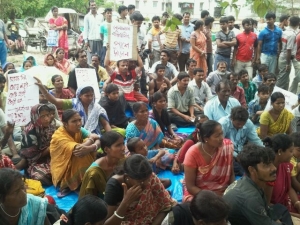
Sit-in by evictees
But this peaceful demonstration was broken by the Kolkata police, who alleged the assembly as ‘illegal’ despite having granted prior permission for the same. 69 protesters of ‘Uchchhed Pratirodh Committee’ (Anti-eviction Committee of Nonadanga) were arrested and transported to Lalbazar police station. A nine-year-old girl child, Manika Kumari, daughter of Dilip Shaw, was in the lock-up for nine hours; Manika Kumari’s detention violated the Juvenile Justice (Care & Protection of Children) Act, which starkly reminds us of Payel Bagh’s case during the Singur unrest. The police deliberately did not, moreover, issue any Memos of Arrest—another violation of legal procedures.

Continuing with the high-handedness, cases under section 151 of the IPC were slapped on the detainees. During the evening of April 8, all the arrested persons were released on PR bond in the presence of members of the Association for the Protection of Democratic Rights (APDR) and other activists through the rear gate of Lalbazar police station. However, seven democratic rights activists were not released and remained in confinement, i.e., Debolina Chakraborty, Shamik Chakraborty, Manas Chatterjee , Debjani Ghosh, Siddhartha Gupta, Partho Sarathi Ray and Abhijnan Sarkar. They have been falsely charged with a number of non-bailable criminal cases. When the released activists and others assembled at Lalbazar became agitated at this unexpected development, all were forced to flee by a huge contingent of aggressive police. APDR members proceeded to the central gate of Lalbazar to speak to the officer in charge and lodged a protest. According to the officers on duty, the seven activists had been charged under various sections including 353, 332, 141, 143, 148 and 149 of the IPC and were to be produced at the Additional Chief Judicial Magistrate (ACJM) court, Alipore, on 9 April, 2012.

The seven activists were remanded to police custody till April 12 by the ACJM court in Alipore Court after the state counsel raised the bogey of Maoist links and alleged that the activists were involved in ‘stockpiling of arms, ammunition and explosives at Nonadanga’. On the same day, a protest rally under the banner of ‘Uchchhed Pratirodh Committee’ (Anti-eviction Committee, a common platform of the evictees of Nonadanga and various mass organizations), demanding rehabilitation for dispossessed people in Nonadanga and release of the arrested protesters was to be held at 1 pm from College Square to Writers’ Building. But police prevented the rally from starting and arrested 50 men, 36 women and 4 children accompanying their mothers. They were taken away by 5 prison vans. The rest of the protesters started sit-in there in College Square, in front of the Vidyasagar statue and a gathering began. Engaging in activities like sloganeering, addressing the local people, etc., the College Street protest continued till 8:30pm, until those 86 arrested men and women were released on bail. The saga of state repression continued on April 10 with APDR activists reporting that the police did not allow family members to meet the seven detained activists. While repression continues in full force, the slum area is also being prepared for the real estate sharks waiting for the people to be “cleared off”. It has been reported that the police undertook a “land survey” on April 10 and declared that they would start fencing off the area from the next day. The evicted slum dwellers, who have living in the nearby fields for the past week, have decided to sit on a hunger strike to protest this move by the authorities.

Meanwhile, friends and supporters of Dr Partho Sarathi Ray have launched a campaign for his release. The following statement gives the details:

Dear Friends,

We are writing to bring to your attention the illegal detention of our colleague, Dr. Partho Sarothi Ray by the Kolkata Police. While participating in a peaceful protest against the eviction of slum dwellers of the Nonadanga area of East Kolkata, Partho along with 68 others including several women and one 9 year old girl was picked up by the Kolkata police near Ruby hospital crossing on Sunday, April 8, 2012. This happened despite the fact that prior permission for carrying out the peaceful protest was granted by the Kolkata police. That same evening, the police released 62 of the 69 people arrested but detained 7 including Partho. Various charges were laid against Partho (and the remaining 6 people detained) for activities allegedly undertaken on April 4 (Wednesday) during which the police resorted to lathi charge on women and children and other brutal tactics to break up a similar protest. Partho was not even present at the site of the protest on April 4 and there is documentary evidence of his presence in IISER, Kolkata (Mohanpur Campus, Nadia, West Bengal) on that day where he participated in a faculty meeting of the Dept. of Biological Sciences, interacted with colleagues and students and stayed overnight at the institute guest house.

Subsequently, during a farcical police court hearing on April 9 held at Alipore court, Kolkata, Partho along with others was remanded to police custody till April 12, 2012. A sessions court on April 12, 2012 remanded the seven detained activists to jail custody until April 26th. Some of the charges laid against Partho and 6 others detained are serious falling under sections 353 (assault on public servant), 332 (voluntarily causing hurt to public servant), 141 (unlawful assembly), 143 (punishment), 149 (common objective of disruption). There is some confusion regarding the number and nature of charges laid since the lists obtained from different sources do not match. In asking for the continued detention of these 7 individuals, the government lawyers made the absurd argument that these people, involved in a peaceful protest for which prior permission was given by the police, had potential Maoist links and it is therefore necessary to keep them in police custody to get “information” about “possible stockpiling of arms and explosives” in Nonadanga. This chilling message reveals the sinister design of the police and the West Bengal government and raises serious concerns for the safety and well-being of Partho and others currently in police
custody. It is therefore essential that we, members of the Indian academic community vociferously condemn the illegal detention of our colleague, a reputed scientist, under false charges and raise awareness so that pressure may be brought on the government to quickly release Partho and remove all the fabricated charges laid against him by the police. Friends in the media can help publicize the issue.

You can also help by signing online petitions here:
Release activists arrested for protesting Nonadanga
www.change.org

Aruna Roy and the MKSS have also sent the following statement in solidarity with Partho Ray and others arrested by the Westy Bengal government:

Dear friends,

An eminent scientist Partha Roy, faculty at IISER Kolkata, an alumnus of IISc and a member of Sanhati, a web paper which reports on democratic and human rights issues, was reporting on a protest against slum clearance in Kolkatta on the 8th of April. He and six others have been booked under sections 143, 149, 332, 341, 342, 353 of the IPC and have been detained unfairly for alleged participation in a protest which took place on the 4th( details in the petition). As it so happened Partha Roy was not there that day, but in the Institute and there is documentary evidence and testimony to prove this.

Despite all this being presented at court he was refused bail by a Kolkata court on the 9th. Intimidation, illegalities and abuse of
power must be questioned and stopped .

In solidarity.
Aruna
Aruna Roy , Nikhil Dey, Shankar Singh and the MKSS

Tuesday, February 1, 2011

Letter from PSSS to Jairam Ramesh, August 2010

http://kafila.org/2011/02/01/a-green-signal-for-the-rape-of-justice-and-the-people-posco-pratirodh-sangram-samiti/

The following is the statement issued by the POSCO PRATIRODH SANGRAM SAMITIon the latest decision of the Environment Ministry on POSCO. The image below from an earlier round of land acquisition attempt is a telling illustration of how the ‘free market’ functions. Received via Shankar Gopalakrishnan.

Courtesy The Hindu

Land being acquired for POSCO. Image courtesy The Hindu

Jairam Ramesh and the UPA government have shown their true colours with their decision today on the POSCO project. Ignoring the reports of its own advisory bodies and enquiry committees, violating its own orders and the laws of the land, this Ministry has shown that the naked face of corporate greed – it is not the “rule of law”, the “aam aadmi”, “inclusive growth” or any of these other lies – that rules this country. The decision today can be summarised in one sentence:”Repeat your lies, give us promises that we all know are false, and then loot at will.”

We repeat: we will not give up our lands, our forests and our homes to this company. It is not the meaningless orders of a mercenary government that will decide this project’s fate, but the tears and blood of our people. Through the road of peaceful demonstrations and people’s resistance we have fought this project, in the face of torture, jail, firings and killings. If this project comes it will come over our dead bodies.
We note the following about today’s decision:

The Orissa government has been asked to give an “assurance” that the affected people of the area are not forest dwellers under the Forest Rights Act, after which the “final forest clearance” will be granted. The Orissa government has already lied on this count on numerous occasions. Indeed, the majority report of the POSCO Enquiry Committee said “The Committee finds that the government’s own records such as census reports and voters list confirm that there are both other traditional forest dwellers (OTFD) and forest dwelling Scheduled Tribes in the project area and the statement of the District Collector of Jagatsinghpur to the contrary is false” (para II.1, Conclusions and Recommendations). Even the dissenting member agreed that the Act had not been implemented. The same finding had been reached by the subcommittee of the Saxena Committee earlier. After the Ministry’s own enquiry committees have found the Orissa government guilty of lying, what is the meaning of saying the project can proceed if the liars repeat their lies?

This Ministry has earlier made a song and dance of respect for people’s views and environmental laws. Under the Forest Rights Act, the consent of the gram sabhas of the area is an essential requirement, and this was confirmed by the Ministry’s own order. Three different committees – the Saxena Committee, the POSCO Enquiry Committee and the Ministry’s own Forest Advisory Committee – all therefore said the clearance should be withdrawn. The Minister today claims that the project can go ahead if he and the Orissa government decide they want it to. So much for the law and for people’s rights.

On the environment clearance, we recall again the words of the majority Enquiry Committee, which said “Potentially very serious impacts…have not even been assessed, leave alone planned for…The cavalier and reckless attitude of the concerned authorities to such potentially disastrous impacts is horrendous and shocks the collective conscience of the Committee….There appears to be a predominant belief that conditionalities in the EIA/ CRZ clearances are a substitute for comprehensive evaluation and assessment of the environmental impact by the authorities. Imposing vague conditionalities seems to be a way out for the various agencies from taking hard decisions on crucial issues.” Again, it is not us who said this – it is the Ministry’s own Committee! And yet this is exactly what the Minister has chosen to do.

Independent reports and studies by reputed academics have confirmed what we have always said – this project will be of no benefit to anyone except POSCO’s profit margins. But yet we find this being called a project of “strategic importance.” To whom?

Today the veil stands ripped open; the government stands exposed before the nation, a mercenary willing to put its regulations, officials and security forces at the disposal of the highest bidder. Let the UPA and the Central government answer: where is the rule of law today, in the name of which you crush struggles across the country? Where is your much vaunted love for the people and for the environment? What do you stand for if not for corporate greed?

Prashant Paikray
Spokesperson, PPSS
09437571547

Letter from PSSS to Jairam Ramesh, August 2010

http://kafila.org/2010/08/19/posco-pratirodh-sangram-samiti-to-jairam-ramesh/

This is a press release issued in August 2010 by PPSS, pointing out the illegalities being committed by the Orissa government and the Central Ministry of Environment and Forests in connection with the POSCO project.

POSCO PRATIRODH SANGRAM SAMITI

Dhinkia, Nuagaon, Gadkujang; Jagatsinghpur District, Orissa

11.08.2010

To:

Shri Jairam Ramesh

Minister of Environment and Forests

Paryavaran Bhavan

New Delhi

Sub: Regarding POSCO project – need for withdrawal of illegal final clearance; new Meena Gupta Committee clearly aimed at delaying matters

Dear Sir,

We are the people’s organisation spearheading the struggle against the illegal and unjust POSCO project in Orissa. We are writing to you in the context of the ongoing illegalities being committed by the Orissa government and the Central Ministry of Environment and Forests in connection with this project. We also condemn the decision of the Ministry to constitute yet another Committee to “look into the matter” instead of remedying its own illegal decision to grant final forest clearance to the project on December 29, 2009.

We wish to bring the following to your attention. While we welcome the stop work order of the Ministry dated August 6, 2010, we condemn the Ministry’s failure to withdraw the illegal clearance granted on December 29, 2009 to the project.

We, political leaders and now your Ministry’s own Committee to Study the Forest Rights Act (the NC Saxena Committee) have all pointed out that:

1. We are indeed Other Traditional Forest Dwellers and eligible for rights under the Forest Rights Act, 2006. It may be noted that the palli sabhas of Dhinkia, Nuagaon and Govindpur have also asserted this fact and it is therefore now simply illegal for any other authority to deny it without going through the process under the Forest Rights Act.

2. As we are other traditional forest dwellers, our consent is required for the

diversion of any forest land (this is also stated in your own Ministry’s circular of August 3, 2009). The palli sabhas of Nuagaon, Dhinkia and Govindpur have denied consent to any diversion on February 4, 5 and 6 of this year, which has also been admitted by your Ministry in its latest “stop work” order.

3. The process under the Forest Rights Act has not been completed in the area. No rights have been recognised and no claims processed. This has also been admitted by the Ministry and by the Orissa government itself, which has said in writing to you that it has not processed any claims.

In short, every single condition required with respect to the Forest Rights Act for a legal forest clearance has not been met; but the clearance was granted anyway on December 29, 2009.

Moreover, now that the palli sabhas have denied their consent, all other issues become irrelevant, and the clearance is invalid in any case. If the Ministry intends to comply with the law, it has no choice but to withdraw the clearance and reject the project’s application.

Yet instead of doing this, we now find the Ministry has constituted yet another Committee to “investigate” the status of “implementation of the Forest Rights Act” as well as “relief and rehabilitation” (vide its order dated 28.07.2010). It is clear that this new Committee is nothing but a delaying tactic intended to muddy the waters. What exactly is this Committee going to

do?

Please consider:

· The Committee cannot investigate whether or not we are eligible under the Act; we have already produced documentary proof of the same which has been accepted by the NC Saxena committee. In any case, at the most this can only be challenged by anyone through the process under the Forest Rights Act; the District Collector’s lies about the lack of eligible persons have no legal standing and should have been rejected in the first place. How many more Committees do you need to “investigate” this matter? What are they going to “investigate”?

· Although we are eligible under the Forest Rights Act, the Orissa government itself admits that it has not processed any claims. It is therefore clear that the Act has not been implemented. What exactly is there for the Committee to “ascertain”?

· The fact that the palli sabhas of Dhinkia, Nuagaon and Govindpur have denied consent for the project in February 2010 is known and accepted. This requires no “investigation” except looking at the concerned panchayat registers. The clearance is therefore invalid. How then is any further investigation relevant?

· The key question before the government is why the Ministry issued a clearance on December 29, 2009, in violation of the law and its own orders and despite having none of the required documents. This can only be answered by the Ministry, not by any inquiry in our area.

· There is a direct conflict of interest in the composition of the Committee, in that the Chairperson was herself the Secretary of Environment and Forests when the project was granted environmental clearance. As such she is being asked to review a project which she has already taken a decision in favour of.

We may also note that on June 22 the MoU with POSCO for this project lapsed. In light of this the entire basis for the forest clearance becomes infructuous as there is no longer any project in existence. If a new MoU is signed, the existing clearance is in any case invalid as it relates to the earlier proposal.

In sum, there is no purpose in the Committee “investigating and ascertaining” any matters with respect to the Forest Rights Act. It also cannot look into any questions of “relief and rehabilitation” because no rehabilitation has been done yet. It cannot even consider the general wisdom of the clearance because there is no longer any clarity on what the project is.

We therefore reject this irrelevant Committee as an obvious attempt to delay and confuse matters. No doubt some elements will try to use it to muddy the waters and come up with bureaucratic excuses for continuing to violate the law. We call upon you to cancel this committee, withdraw the illegal forest clearance and finally reject the application by POSCO India for diversion of forest land in Jagatsinghpur. This is the minimum that is required by law.

We will continue our peaceful and democratic agitation for our rights.

Sincerely,

Abhay Sahoo

Chairperson

POSCO Pratirodh Sangram Samiti

Contact:
Prashant Paikray,
Spokesperson,
POSCO Pratirodh Sangram Samiti
09437571547

Thursday, July 15, 2010

An Appeal to join the Candle Light Protest in Kolkata from Concerned Citizens for Kashmir

http://www.facebook.com/notifications.php#!/event.php?eid=129173233791446


Tufail Mattoo (17)
Javid Ahmad Maila (18)
Shakeel Ahmad Ganai (14)
Firdous Ahmad Kakroo (17)
Asif Hassan Rather (9)
Ishteyaque Ahmad Khanday (15)
Imtiyaz Ahmad Itoo (17)
Muzaffar Ahmad Bhat (17)
Abrar Ahmad (17)

These are some of the twenty or so civilians killed by the security forces in the past month. The home minister has come out with statements like: “Parents should ensure that their children remain indoors. It is the responsibility of parents,” He further said that the purpose of moving in the Army was to “serve as a deterrent.” The Army would be in Kashmir “as long as it is necessary” to deal with the situation there. Fingers have been pointed at terrorist groups as well as the half-hearted attempts of the ruling NC state government to control the situation. But it is increasingly clear that spaces for civil dissent in Kashmir are few and continually shrinking. The armed forces have been used to crush all forms of civilian dissent in Kashmir and the protests and protesters in the valley are always criminalised more than anywhere else in the country.

No one from the central government has come out with a statement expressing grief at the loss of so many young lives and consoling the bereaved families. And all the while the civilian death-toll is mounting and will continue to do so as long as the Armed Forces (Jammu and Kashmir) Special Powers Act, 1990 (AFSPA)—which gives army officers the power to open fire on protesters and anyone else they decide is a potential lawbreaker whilst granting all personnel impunity from prosecution under civil law—remains in force in Kashmir.

Whatever our separate and individual takes on azaadi and armed insurgency, there cannot be any doubt that these killings of unarmed civilians—mostly angry teenagers—by the armed forces in Kashmir are gross violations of human rights and civil liberties. We must come together to

1. express our solidarity with the families of those who have been killed in the recent events and also with those who are protesting against the continued presence and the misconducts of the armed forces in the valley
2. strongly condemn the violence and the role of the security forces
3. insist that the Government of India and the state government take immediate action to prevent further loss of life and property and initiate an impartial investigation into the recent killings
4. demand the immediate repeal of the Armed Forces (Jammu and Kashmir) Special Powers Act, 1990 (AFSPA)
5. demand immediate steps for the gradual demilitarization of the valley with troops confined to the border areas


A candle light protest will be held on July 24, 2010 in front of Academy of Fine Arts between 5pm and 8 pm to protest and denounce the killings and human rights violation in Kashmir in the past weeks. We invite you to come and join the vigil and voice your protest. Please forward this appeal to others. We are also sorry about crosspostings, if there are any.

We would also request you to get in touch with us by July 16, 2010 to let us know if you would like to support and participate in the vigil.


Thanks,

Aniruddha, Debjani, Madhura, Parjanya

(on behalf of Concerned Citizens for Kashmir)

About Concerned Citizens for Kashmir: We are a group of citizens who have come together to express our concern over the events in Kashmir and to express our solidarity with the people affected by the 20 years of conflict there. We have no affiliations to any other groups.

Sunday, June 27, 2010

STATEMENT on arrest of Dr. Nisha Biswas and other civil rights activists in Lalgarh

We, the undersigned organizations and individuals, are shocked by the arrest on 14th June of Dr Nisha Biswas, Scientist - Central Glass & Ceramic Research Institute Kolkata, Manik Mandal, writer, Kanishka Choudhary, school teacher, and ten other persons by the W Bengal police from Lalgarh area, where they had gone at the request of the local people to investigate human rights violations by police and paramilitary. At the time of their arrest they were charged with violation of Sec 144 (anticipated major public nuisance or damage to public tranquility), a bailable offence. However, when produced in court on 16th June they were charged with several false cases, such as waging war against the state, criminal conspiracy, and unlawful assembly, and remanded to 14 days jail custody. On 25th June, a bail hearing requesting her transfer to police custody- on the spurious evidence of an alleged photograph in her camera- was rejected by the court and her bail hearing is due on 6th July.
We believe that this is not an isolated incident, but part of the repression and reign of terror let loose by the central and state governments over the past few years in the tribal parts of central India to crush dissent, and the accompanying attempts to delegitimize and criminalize all dissent and opposition to its policies.
On one hand, the state has launched an armed offensive in the forested tribal areas of Chhattisgarh, Orissa and West Bengal, in the name of countering the `Maoist menace’, to actually destroy the numerous resistance movements against forced acquisition of their land for mining and big industry, against displacement from their land and homes and loss of their livelihoods. This has been accompanied by the increasing use of extra-judicial killings and arbitrary arrests of villagers and leaders, and extra-legal measures that curb ordinary freedom of expression. Lalgarh area of W Bengal has been a site of intense police repression for more than a year now and under Section 144 for as much period. Civil society persons have not been allowed to visit the area and attempts to do so have been met with detentions and arrest. In Chhattisgarh there has been use of the draconian CSPSA to stifle opposition and of non-state actors like Salwa Judum that terrorises and kills villagers, destroys their homes, perpetrates sexual violence against women, and forces them into camps, or to desert their home and hearths and flee to neighbouring states.
On the other, the state has been suppressing in several ways efforts of civil liberties/democratic rights activists to expose the lawlessness and brutalities being committed in these areas by the security forces and to inquire into issues of violation of people’s rights in the process of `development’ of these areas. These tribal areas have been rendered out of bounds for people from outside the area, in violation of all Constitutional provisions regarding freedom of movement and of expression. Any person or group of persons visiting these areas, or talking about or writing about the situation there, or raising questions about the deployment of paramilitary forces in such large numbers is harassed, intimidated, or arrested and labeled as `Maoists’ or `Maoist sympathizers’, thus criminalizing all such democratic rights activities. Starting with Dr. Binayak Sen in Chhattisgarh, a large number of civil liberties activists across the country have been illegally arrested and implicated under false charges of `waging war against the state’ and accused as `Maoists’. Just over the past three months 14 people - trade unionists, forest rights activists and ordinary people - from Gujarat have been arrested under an omnibus FIR.
The recent arrest of Nisha Biswas and others, and the shrill tirade against writer Arundhati Roy, are part of this trend of targeting civil and political rights activists and urban intellectuals, and discrediting them for raising questions, for sincerely carrying out their democratic responsibility of drawing attention to violation of Constitutional and legal safeguards.
We are also deeply concerned by the extreme intolerance being displayed by the state and sections of urban society towards Arundhati Roy for her views on development, displacement, on the situation of the tribals, the violation of their Constitutional rights, and the military offensive of the state. Freedom of expression and vigorous discussion and debate are indispensable for a true democracy. Instead of carrying forward an informed debate on the issues raised by her, attempts are being made to stifle her voice by vicious abuse, public threats of arrest and much more. It is very disturbing that sections of the media too have been (ir)responsible and complicit in this matter, by false reporting of Ms Roy’s statements to suit their requirements. We also take this opportunity to condemn the statement reportedly made by a BJP leader of Chhattisgarh that Ms Roy 'should be publicly shot down'. That such public incitements to kill a person are ignored by the state machinery exposes the extent of double standards and hypocrisy that characterize our political institutions and leaders. Such intolerance to Ms Roy’s writings and speeches not only makes a mockery of the claims of this country to being a `great democracy’ that grants immense freedom of expression to its citizens, it also poses a grave threat to the spirit of critical public discussion and debate warranted on crucial issues such as development and marginalization.
We are also extremely disturbed and anguished by the reports of rape and other forms of sexual violence by the security forces and Salwa Judum against innocent village women in Chhattisgarh as `punishment’ for alleged support to `maoists’. We ask of the political leadership - in this `war against the Maoists’, for that matter in any place whether it be in Kashmir or the north-east, why are women systematically targetted for sexual violence by the security forces? As already stated above, any attempts to bring this to light and extend assistance are also prevented by intimidation of the affected women. By not taking any action ever against the perpetrators the entire state machinery is accessory to these gruesome acts.

In this situation, we demand:
1. The immediate release of Dr. Nisha Biswas and others arrested along with her.
2. The witch-hunt against Ms Roy be ended.
3. Strict measures be taken against the security forces to put an end to the sexual violence being perpetrated by them against women.
4. We once again demand immediate withdrawal of the armed offensive against the tribal population. Instead, as expected of a democratic government, the government should move towards addressing politically the long-standing grievances of the tribal population, which have been explicitly pointed out and discussed by the government’s own report.

We strongly urge all other democratic minded women’s groups and organizations to join us in this urgent appeal to the Indian government and the respective state governments.

25 June 2010

Women Against Rape and Repression (WARR)


Women Against Rape and Repression (WARR) is a network of individuals and women’s and human rights organizations from across India. It is a non-funded effort initiated by women, and is concerned with atrocities and repression against women by state and non-state actors, especially in conflict zones.
Those who would like to endorse this statement, in their organisational or individual capacity, please revert by 28/06/2010, at which point we will forward the statement to various officials in the government/s.

Endorsed by:
AIPWA (Delhi)
Anhad (Delhi),
CAVOW-India,
Chhattisgarh Mahila Adhikar Manch,
Jagrit Adivasi Dalit Sangathan (Madhya Pradesh),
Madhya Pradesh Mahila Manch,
PUCL-India,
Saheli (Delhi),
Vidyarthi Yuvjan Sabha
WinG-India,

Individuals:
Indira Chakravarthi,
Dr. Uma Chakravarthi
Uma V. Chandru
Dr. Leena Ganesh
Kamayani Bali-Mahabal
Priti Turakhia
Ranjana Padhi

Wednesday, March 10, 2010

Protest to the Prime Minister of India against ‘The Civil Liability for Nuclear Damage Bill 2009’

Sign the petition here: http://www.petitiononline.com/no2cap/petition.html

Dear Dr. Singh,

We, the undersigned, hereby express our grave concern over the recent press reports that ‘The Civil Liability for Nuclear Damage Bill 2009’ is planned to be tabled in the ongoing Budget Session of Parliament and the UPA government is apparently bent upon rushing it through without holding fair and transparent public consultations, regardless of its profound consequences.

A quantum leap in installed capacity for nuclear power generation, from the current level of 4,120 MW to 63,000 MW by 2032, which you have committed yourself to, is but an invitation to disaster given the intrinsically hazardous and potentially catastrophic nature of the industry. It is necessary to further bear in mind that the health burden, clean-up and recovery costs for damages arising out of any nuclear accident are irreversible in consequence and generational in effect, poisoning not just human beings in the vicinity of a nuclear plant but the web of life itself through air, water and soil contamination.
Yet, pretty much shockingly, the nuclear liability bill, approved by the Union Cabinet in last November, understandably overriding strong objections even from two nodal ministries, viz. Finance and Environment, appears to pave the path for the entry of private enterprises, known to cut corners to maximize profits, not just as equipment suppliers but also as operators of nuclear power plants.

The nuclear liability bill, as per the reports leaked in the media, proposes to cap the total liability amount to 3 hundred million Special Drawing Rights. This works out to just about a paltry US$ 450 million or Rs 2100 crore per accident. We find it inconceivable and outrageous that any cap, let alone such a meagre one, be placed on the total liability, regardless of the scale of disaster.
Ironically, the total liability cap amount now being proposed, $450 million, is marginally less than the amount awarded in the Bhopal Gas case way back in 1989, which was a gross under-assessment of liability even at that time. Today, more than two decades since, and given that a major nuclear disaster could very much dwarf the Bhopal disaster, the proposed nuclear liability cap appears to be truly a slap in the face of the people of this country. Further, while the supplier of nuclear equipment would enjoy standard indemnity, the maximum liability of the operator reportedly would not exceed the ridiculously low amount of Rs 300 crore or thereabout. In fact, it may even be as low as Rs 100 crore. This cannot but be considered as a brazen move towards helping profiteering corporations while penalizing the unsuspecting Indian people, who have elected you to the office you hold.

We further draw your attention to the public statement of former Attorney General of India, Soli Sorabjee, that putting a cap on nuclear liability violates the very Right to Life as enshrined in Article 21 of the Constitution.
It is shocking that a bill that compromises the Right to Life is being pushed through without soliciting the opinion of the people of the country, whose health and well-being, safety and human rights, and life, are being put directly in danger.
This is just unacceptable. We strongly condemn any attempt to introduce any caps whatsoever on nuclear liability and that too without widespread public debate on the issues involved.

Hence we demand that the contents of the proposed nuclear liability cap bill be disclosed forthwith to the public.
We further demand that widespread public consultations be held before any attempt is made to introduce such profound changes in the nuclear liability regime.

Monday, March 8, 2010

Statement on Maoist attack on police camp in West Bengal

Statement on Maoist attack on police camp in West Bengal


We the undersigned would like to express our deep concern at the
ongoing conflict in the Jangalmahal area of West Bengal where forces
of the CPI (Maoist) and the Indian government have been confronting
each other for the past year.

The regular incidents of violence have resulted in the tragic loss of
too many lives already- both of combatants and innocent civilians-
and needs to come to an immediate end. The systematic annihilation of
opponents and the gross violations of human rights by both sides in
the conflict are a serious setback to the task of building a more just
and humane Indian society.

In this context the attack by the CPI (Maoist) cadre on the Silda
police camp in West Bengal on 15 February killing 24 policemen
represents a severe escalation of an already ugly situation in the
Jangalmahal area. Coming at a time when there are active attempts
being made by many sections of civil society to get the Indian
government to call off its proposed ‘Operation Green Hunt’ against the
Maoists this provocative act by the latter can only result in a
hardening of attitudes all around.

While there are many genuine grievances of the local population
against the West Bengal state government and the security forces
operating in the tribal areas of West Midnapore – including arbitrary
arrests and killings- none of them can be used to justify the latest
Maoist action. In fact the purely military methods adopted by the CPI
(Maoist) are inimical to the task of finding both short and long-term
political solutions to the long-standing problems of the local people.

Use of violence for political goals, however lofty, cannot mean
violation of fundamental principles of humanity and there are also
basic norms and conventions that need to be adhered to. Every such
killing and violation adds to the spiral of grief, trauma and revenge
that is already consuming our polity; and from which the common people
desperately need relief.

Monday’s attack on the Silda police camp also represents a
contradiction of the CPI (Maoist)’s own stated position, through media
interviews of its top most leaders, of the need for talks with the
government of India and the prevention of an ‘all out war’. The
massacre of police personnel also shows a lack of seriousness on the
part of the CPI (Maoist) about its own publicly stated demand that for
‘any kind of democratic work, the ban on the Party and Mass
Organizations have to be lifted’.

The Indian State too should immediately stop all its violations of
human rights in the Jangalmahal area, sincerely settle the problems of
the local people and not use the latest Maoist attack as an excuse to
go ahead with further intensification of the conflict.
We the undersigned sincerely hope for a quick and peaceful resolution
to the conflict, which is putting at grave risk the lives of a very
large number of innocent people trapped between the Maoists and the
Indian State.

Prof. A. Marx, Chennai
Bhaskar Vishwanathan, Chennai
Praful Bidwai, New Delhi
Dileep Simeon, New Delhi
Apoorvanand, New Delhi
Aditya Nigam, New Delhi
Nivedita Menon, New Delhi
Amit Sengupta, New Delhi
Satya Sivaraman, New Delhi

Thursday, March 4, 2010

India: Appeal for talks with broader section of people’s struggles in the forest and mineral belt

Aditya Nigam, Dilip Simeon, Jairus Banaji, Nivedita Menon, Rohini Hensman, Satya Sivaraman, Sumit Sarkar, Tanika Sarkar

In the light of the recent demands raised by sections of the intelligentsia urging the government to heed the CPI (Maoist) “offer of talks”, we insist that “civil society” should rather put pressure on the government to initiate talks with representatives of all struggling popular and adivasi organizations. The CPI (Maoist) cannot be treated as the sole spokesperson of all the people in the forest and mineral belt, convenient though this may be for the state and for that party. Does the government believe that violent insurgents are the only deserving interlocutors?

There is a common pattern to the emergence of Maoist violence in many areas. First a non-violent mass organisation like the Peoples Committee Against Police Atrocities (PCAPA) in West Bengal or Chasi Muliya Adivasi Sangh (CMAS) in Orissa arises in response to marginalisation, displacement or violence against tribals by the police and paramilitaries. Then the Maoists step in, attempting to take over the movement and giving it a violent turn. The state responds with even more violence, which is directed not only against the Maoists but also against unaffiliated adivasis. At this point, some adivasis join the Maoists in self-defence, their leaders like Chhatradhar Mahato, Lalmohan Tudu, Singanna are either arrested or gunned down in fake encounters and large numbers of unaffiliated adivasis are branded Maoists or Maoist sympathisers and arrested, killed or terrorised by the state. Clearly, Maoist violence in these cases obtains legitimacy because of the unbridled use of force by security forces and violations of the fundamental rights of the local people. On the other hand, the unilateral and doctrinal use of the language of warfare by one armed group obscures the political agency of the ordinary people who have had no say in this declaration. It also tramples on the human rights of the often desperately poor people who are obliged to seek a livelihood in organisations of the state. Furthermore, it is not clear that the CPI (Maoist) actually shares the rejection of this kind of “development” by the people of the area, or whether it only wants to wrest control of this process from the Indian state.

The counter-insurgency operations mounted by the central government in these areas has led to unprecedented bloodshed, massacres of civilian populations and rampant violations of constitutional rights in the area. The central government insists on treating the affected areas as a “war zone”, and has shown little inclination towards tackling the huge backlog of tribal oppression that has created fertile ground for such violence. It is also true that whenever the government has conceded space, the conditions for this have been created by mass movements, not by the military actions of the CPI (Maoist). For example, the decision by the Ministry of Environment and Forests to put on hold the agreements with Vedanta and Posco in Orissa due to their non-compliance with legal requirements for obtaining the consent of local adivasis, comes in the wake of sustained joint struggles by a range of political groupings.

We therefore urge all democratic sections to put pressure on the government to ensure that:

(1) Regardless of whether talks with the Maoists materialise, talks should immediately be initiated with those adivasis who are losing their land; and with representatives of the various mass-based organisations/mass movements, if necessary by securing their release from prison.

(2) round-the-clock security from attacks by both Maoists and state-sponsored groups and security personnel be provided to these representatives and their families, as well as to witnesses in cases like the Gompad massacre and their families;

(3) the grievances voiced by these representatives be treated with the utmost seriousness and addressed as soon as possible.

Maoist violence flourishes in the fetid atmosphere provided by the destruction of the rule of law and rampant human rights abuses by the state. If the rule of law is ensured in the forest belt and all democratic rights of the adivasis to freedom of association and freedom of expression, including the right of dissent to current “development” policies, are respected, and this dissent taken into account by the government, the Maoists will lose credibility and their deliberate use of violent methods, often designed to invite collateral damage, will lose any basis for flourishing in these areas.


See Also:
http://development-dialogues.blogspot.com/2010/03/government-should-respond-to-maoist.html

Wednesday, March 3, 2010

Government should respond to Maoist offer - Press Statement by Concerned Citizens

We welcome the announcement by the CPI (Maoist) to observe a ceasefire and enter into talks with the Government of India. Given the government’s expressed willingness to engage in talks, we hope that this offer will be reciprocated. This necessarily requires a halt to all paramilitary armed offensive operations (commonly known as Operation Green Hunt) immediately. It is also imperative that there should be complete cessation of all hostilities by both sides during the currency of the talks.

We are of the view that the Central Government, and not the State Governments, should be the authority to conduct talks as the problem covers various states.

Additionally, the Central Government should ensure that, while the talks are being held, all MOUs, if entered into, should be frozen and not implemented; no compulsory acquisition of tribal lands and habitats be undertaken; and tribals should not be displaced. This is because the Central Government is bound under law to strictly comply with the Fifth Schedule of the Constitution that, among others, safeguards manifold rights of the tribals including their ownership over land and resources.

We further urge that during the period of the ceasefire and the course of talks, independent teams of observers and human rights groups should not be prevented, by either side, from going to the affected areas.

Justice Rajindar Sachar, Randhir Singh, B.D. Sharma, Arundhati Roy, Amit Bhaduri, Manoranjan Mohanty, Prashant Bhushan, Sumit Chakravartty, G.N. Saibaba, S.A.R. Geelani, Madhu Bhaduri, Karen Gabriel, P.K. Vijayan, Saroj Giri, Rona Wilson, Anirban Kar

New Delhi

23 February 2010

Concerned Citizens, c/o Sumit Chakravartty
B 57 Gulmohar Park (1st Floor), New Delhi 110049


See Also: http://development-dialogues.blogspot.com/2010/03/india-appeal-for-talks-with-broader.html

Thursday, November 12, 2009

Open Letter to Noam Chomsky: Nirmalangshu Mukherjee

http://kafila.org/2009/10/21/open-letter-to-noam-chomsky-nirmalangshu-mukherjee/

Posted by Aditya Nigam

[We publish below an open letter to Noam Chomsky, written in the wake of his endorsement of a statement against 'Operation Green Hunt', issued recently by a large number of intellectuals in India and in the US. Nirmalangshu's letter is important because it raises some very serious questions that are being brushed under the carpet by sections of the radical intelligentsia. Unlike Nirmalangshu, I would not put 'radical' within scare quotes, since it is precisely this that highlights the immense tragedy of our times. Radical intellectuals - truly radical intellectuals - once again find themselves caught in this situation where in order to oppose state violence, they will wilfully turn a blind eye to the violence of armed nihilist gangs, simply because these claim to speak on behalf of the oppressed - a claim that Nirmalangshu's letter exposes in all its falsity. He lays bare how the politics that goes by the name of 'Maoism' (i.e. CPI-Maoist) believes in violently erasing all other voices of opposition to and criticism of the state, but that of itself. This brand of politics in fact lives in symbiosis with the state - delegitimizing all forms of mass democratic politics. At this moment one deeply misses the courageous voice of the late Balagopal - recently slightingly dubbed a 'liberal humanist' by a spokesperson of the Maoists, at a meeting meant to salute his memory. I cannot help recalling here the feeling of immense sadness many of us were overcome by, watching and hearing speakers at this meeting (in Delhi) for Balagopal - speakers who were ungenerous, if not carping and outright dismissive of the courage of conviction that was Balagopal. AN]

Dear Prof. Chomsky,

I saw your support to the statement issued by Sanhati in the form of a letter to the prime minister— endorsed by some intellectuals from India and abroad. Three points are transparent: (a) the Indian government is planning a massive armed operation in the tribal-hilly areas in the eastern part of the country, (b) the poorest of the poor and the historically marginalised will suffer the most in terms of loss of lives, livelihood and habitat, and (c) for whatever it’s worth, an all-out campaign by democratic forces is needed to resist the armed invasion of people’s habitat by any party. To that extent, the statement does bring out the urgency of the matter.

What is not so transparent from the statement is the condition that has brought about this state of affairs. It is said that large-scale neo-liberal policies—including formation of SEZs and encroachment of tribal habitats for mining and other forms of exploitation—has led to mass impoverishment. So, in desperation, the poor have allegedly taken up arms to defend themselves.

This picture is wrong in (i) ascribing the so-called armed struggle to the people, and (ii) being silent about the ’specific’ source of the current aggression by the state, namely, the armed operations of CPI (Maoist). The statement is otherwise right about the ‘general’ situation: sinister neo-liberal policies, growing impoverishment and marginalisation of the poor, and the resulting anger thereof.

Hundreds of organisations working at the grass roots level across the country are engaged in a variety of struggles against state repression and the insidious economic policies of the government. This includes many Gandhian, liberal and leftist organisations and individuals. Importantly, some of these—such as the organisations led by veteran activists Kanu Sanyal and Asim Chatterjee, among many others in Bengal, Andhra, Bihar, Orissa and elsewhere—also subscribe to maoism and are known initiators of the original naxalbari movement. Thus, the labels ‘maoist’ and ‘naxalite’ apply to a much wider category of organisations and individuals than the CPI (Maoist). Needless to say, even the wider category of maoists, not to mention just the CPI (Maoist), forms a tiny fraction of the broad democratic resistance to the policies of the state. The current armed operations of the state are directed ostensibly against the CPI (Maoist) in the areas under its control.

The state of course makes no such distinction in public; by identifying the wider category with the narrower one, it is constructing the opportunity to target the entire left-democratic fraternity in due course. To put the point differently, although the undeclared target of the state covers the entirety of left-democratic forces—as evidenced, for example, in the growing attacks on industrial workers especially in the private sector—the declared target currently consists of CPI (Maoist) and its area of control. The significance of this specificity is wholly missing from the statement you endorsed.

The identification of CPI (Maoist) with the entire resistance movement suits CPI (Maoist) as well. Its Supreme Commander recently declared from his hideout from a guerrilla-controlled area: ‘People, who are the makers of history, will rise up like a tornado under “our party’s leadership” to wipe out the reactionary blood-sucking vampires ruling our country … our party’s influence has grown stronger and “it” has now come to be recognised as the only genuine alternative before the people.’ (Open magazine). We will evaluate the factual content of this declaration below.

For now, it is interesting to note the character of the propaganda: somehow the propagandist interests of CPI (Maoist), the state, and the corporate media suitably converge. The Supreme Commander’s claim is grimly endorsed by the prime and the home ministers of India; according to them, the ‘naxalite menace’ is the greatest threat to internal security. It is also endorsed by the corporate media: the ‘menace’ is said to have spread in 15 of about 25 states, and in 180 of about 500 districts of the country—the numbers accelerating each month to encourage the prospect of a ‘civil war’ soon across the country. The Central government frequently convenes high-profile meetings of chief ministers, secretaries, and police chiefs of the country to meet the challenges posed by the menace. Cutting-edge special forces, carved out of the paramilitary forces, are being constructed and deployed in ‘naxal-infested’ areas. In recent months, even the army and the air force are beginning to enter into the picture. Naxalite actions—widespread arson, mass killings, and the ability to take on the security forces—are prominently reported in the corporate media with ill-concealed awe. This strand of the naxalite movement never had it so big in its close to 40 years of existence in hideouts in remote jungles.

As for the factual content of this dramatic story, I will briefly record some facts that do not find a place in the three-pronged propaganda.

- CPI (Maoist) is a comparatively new organisation formed in 2004 when two naxalite factions Maoist Coordination Committee (MCC) and People’s War Group (PWG)—located primarily in some tribal-inhabited jungle areas in Bihar and Andhra Pradesh respectively—decided to join hands after fighting a bloody war for area-control among themselves for close to two decades. By 2006, CPI (Maoist) was almost completely wiped out from Andhra after their presence there for close to forty years. They also lost major areas in Bihar. The organisation has basically shifted to two of the most backward, tiny, and newly-formed states of Jharkhand and Chatthisgarh. As noted, even there, their presence is basically centered in the areas of dense forest and adjacent tribal-dominated villages, especially in the Bastar district. Ostensibly, as the jungles extend from their headquarters, they have also developed some hideouts and some armed squads to create enough violence to mark their ‘presence’ in West Bengal, Orissa, and elsewhere. To sum, they have essentially failed to emerge out of portions of jungles of eastern India after over four decades of campaign for this particular strand of ‘Marxism-Leninism-Maoism’.

- The organisation has no presence whatsoever in the vast agrarian and industrial terrains of the rest of the country. It has no trade union, no peasant organisation worth its name, no penetration in the dalit, youth, and women’s movements. But it seems to have captured the imagination of sections of elite, urban, and ‘radical’ intelligentsia in Calcutta and Delhi who have impressive connections with some Indian intellectuals settled in universities abroad, as the statement you endorsed highlights (earlier, this intellectual support used to come from Bombay and Hyderabad). The phenomenon is historically familiar.

- ‘The only genuine alternative before the people’ is viewed as a terrorist organisation by none other than Kanu Sanyal and many other active maoists, not to speak of broad spectrums of left parties and organisations most of whom do not find a representation in the statement. The basic reason why Sanyal calls CPI (Maoist) ‘terrorists’ is as follows.

Ever since its inception in 1969, this brand of maoism rejected all classical forms of mass struggle and adopted the sinister doctrine of individual annihilation of ‘class enemies’. ‘Class enemies’ typically consisted of hapless, poorly armed police constables, petty landlords and traders, and an assorted category of ‘informers and traitors’. Most notably, the category of ‘class enemies’ also included grass-root cadres—not their leaders—of the parliamentary left. In the states of West Bengal and Andhra, where this campaign originated, the parliamentary left was typically the only organisation present at the grass root. The annihilation of these ‘class enemies’—typically, middle peasants, school teachers, party wholetimers, etc—effectively meant capturing of areas, by means of guns and knives, already under the left. To that end, the squads first targetted their own maoist fraternity who refused to subscribe to their murderous politics. After the ‘renegades’ were silenced, the next target was cadres of CPI(M), CPI, etc.

This ‘red terror’ basically led to the dismantling of democratic movements in the erstwhile red bastions. In West Bengal, a neo-fascist regime of the Congress Party won the elections handsomely and watched the mutual killings of the left with glee. Once the task was accomplished, the government turned on the maoists and the remaining left and white terror ruled West Bengal for five years. During the nightmare, all forms of democratic movements virtually disappeared from the state as lumpen youth accompanied by paramilitary forces roamed the streets.

In time, almost all of the initiators of this campaign realised their grave mistakes and those who survived encounters, long imprisonment, and psychological collapse, returned to classical mass lines in a variety of forms, including participation in the elections. However, a fragment continued the murderous politics in the jungles of Andhra and Bihar in the form of two organisations MCC and PWG, later unifying into CPI (Maoist), as noted.

Two recent—and contrasting—events in the neighbourhood throw significant light on the consequences of this brand of politics. In Sri Lanka, a vast freedom movement of Tamil nationalism arose about three decades ago. As the movement became progressively militant, it gave rise to a formidable militarist organisation: Liberation Tigers of Tamil Elam (LTTE). LTTE declared armed struggle, systematically eliminated all other groups advocating Tamil liberation, took to the jungles, and launched a civil war.

There were several rounds of ‘negotiations’ between the government and the LTTE, often with international effort. LTTE refused to give up arms and join the democratic process; thus, it used each pause in the hostilities to consolidate its forces. After over twenty years of bloody war with Sri Lankan security forces, resulting in incalculable suffering of Tamil people, the LTTE was recently wiped out from Sri Lanka. The calamity facilitated the emergence of a neo-fascist regime in Colombo; it also left behind nearly a million hapless Tamil refugees at the mercy of this government. With all moderate forces from both the sides eliminated from the scene, the Tamil freedom movement is now faced with a historical setback after over hundred thousand deaths.

The Supreme Commander (cited above), whose organisation was trained in guerrilla warfare by former commandos of LTTE, agrees with the consequences: ‘There is no doubt that the movement for a separate sovereign Tamil Eelam has suffered a severe setback with the defeat and considerable decimation of the LTTE. The Tamil people and the national liberation forces are now leaderless.’ But he puts the blame elsewhere: ‘The jingoistic rallies and celebrations organised by the government and Sinhala chauvinist parties all over Sri Lanka in the wake of Prabhakaran’s death and the defeat of the LTTE show the national hatred for Tamils nurtured by Sinhala organisations and the extent to which the minds of ordinary Sinhalese are poisoned with such chauvinist frenzy.’ Nonetheless, he hopes that ‘the ground remains fertile for the resurgence of the Tamil liberation struggle. Even if it takes time, the war for a separate Tamil Eelam is certain to revive, taking lessons from the defeat of the LTTE.’ Although he is prepared to learn—perhaps, tactical—‘lessons’, he does not seem to have any problems with the militarist, sectarian, and exclusivist politics of the LTTE.

In sharp contrast, the Communist Party of Nepal (Maoist) (CPN(M)) also launched a civil war against a ruthless feudal monarchy protected by the Royal Nepalese Army after all democratic methods failed. The war lasted nearly a decade with the CPN(M)-directed People’s Liberation Army dominating vast terrains of the country with massive popular support. The basic point to note is that what CPN(M) strove for during the armed struggle—republic, constituent assembly, supremacy of the parliament created by universal franchise, etc.—India already has. Once that was achieved in Nepal, a genuine armed struggle—far far superior than anything Indian ‘maoists’ have ever envisaged—was immediately brought to a halt. CPN (M) proved its point by winning over 40% of the seats in the interim parliament after the republic was established. With this mandate in hand, innovative, peaceful but militant processes were then adopted to broaden the democratic base even in a context in which the possibility of a counter-revolution orchestrated by the ousted monarch, the army and the ruling elites of India loomed large.

The current impasse in Nepal is about the supremacy of the parliament over the army. As the leader of CPN(M) Prachanda points out, the democratic movement is at a crossroads due to this seminal conflict. Indian republicanism addressed and solved that problem 60 years ago.

During the war, PWG—followed by CPI (Maoist)—maintained close contact with CPN(M). But after the CPN(M) joined—in fact, established—the democratic process in Nepal, the CPI (Maoist) does not find any lessons to be learned. This time the blame is on CPN(M). As the Supreme Commander puts it: ‘It is indeed a great tragedy that the CPN(M) has chosen to abandon the path of protracted people’s war and pursue a parliamentary path in spite of having de facto power in most of the countryside.’ In a letter to CPN(M), CPI (Maoist) ‘advised’ the former not to give up armed struggle until the ‘old order’ is smashed and the CPN (M) is able to seize power all by itself to usher in ‘new democratic revolution’. However, the Supreme Commander remains optimistic since ‘given the great revolutionary traditions of the CPN(M), we hope that the inner-party struggle will repudiate the right opportunist line pursued by its leadership, give up revisionist stands and practices, and apply minds creatively to the concrete conditions of Nepal.’ So, the statesman-like leadership of Prachanda is ‘revisionist’.

Beyond the bluster, it is not difficult to discern that, no matter what, the CPI (Maoist) is not prepared to give up its fatal policies. They are not open to any debates, no one can enter their ‘liberated zones’ without unconditional support to their line. Like Prabhakaran and his LTTE, having meticulously secured hideouts for themselves in ‘impregnable’ dense forests protected by squads armed with sophisticated weapons, they are prepared to carry on ‘protracted war’ for many years before their inevitable decimation. In the process, not only will the tribals under their control suffer immensely, it will give the growingly authoritarian state a golden opportunity to smash whatever avenues of hard-won democratic resistance still remain in place.

As noted, the CPI (Maoist) has exactly two channels of ‘popular’ support: the tribals they control and a section of ‘radical’, urban intelligentsia. It is the support of the latter that gives the CPI (Maoist) significant propaganda mileage and a false impression of invincibility and popular support. By posing the current military preparations of the state only as a state vs. people conflict, the statement you endorsed effectively exonerates the CPI (Maoist) and plays into their hands.

Sincerely

Nirmalangshu Mukherji
Department of Philosopy
University of Delhi

See Also:

http://development-dialogues.blogspot.com/2009/11/operation-green-hunt-who-is-state.html

Saturday, July 11, 2009

An Appeal

Dear friends,

We, certain students and professors of Jadavpur University, are collecting funds and food grains for the Aila-afflicted in the Sunderbans. We have already reached four villages in Gosaba last week- Bally 8 nombor, Satyanarayanpur 3 nombor, Satyanarayanpur Majherpara, Satyanarayanpur Hatkhola.

We wish to send relief materials to these villages again as we could only send them a very limited supply that would hardly have sustained them for more than a few days. We also hope to reach a few more villages. In the first phase of collection we collected around Rs. 12000/- in cash and 150 kilos rice+50 kilos dal in kind. With the money we bought tarpaulin sheets, 100 kilos chnire, 15 kilos gur, 150 bottles of zeoline, carbolic acid and bleaching powder. We are trying to reach as many people who are willing to help us with a monetary contribution or with a substantial contribution in kind (foodgrains).

For those willing to help us in our relief effort, please mail me at ahonapanda88ATTHERATEOFgmailDOTcom

Thanks again,

Ahona Panda

Tuesday, April 28, 2009

Torture which some Muslim students face at JNU

From: Idrees

Date: 2009/4/22

Subject: help!!!

Dear All,

We want to bring it to your notice the constant physical and psychological violence that many of us muslim students have been experiencing at Jawaharlal Nehru University, New Delhi over the last two years. Recently on On 17th March a Muslim student Masihullah Khan[ M.A. French] was brutally assaulted by a group of ABVP/RSS students inside Lohit hostel in full view of the Senior Waden and fellow residents. Despite that the administration did not deem it be a serious offence and let them off with very mild punishments, which were then revoked. All that was left of the punishment was hostel transfers, and even those were not carried out.

Exactly a month later on 17th April the same group of students assualted me [Idrees Kanth] badly and further threatened me of dire consequences. Even after this, the administration on one ground or other ['humanitarian considerations' is what the adminstration said] has been protecting them making us feel not only very vulnerable but traumatised. Such an attitude of the administration has only emboldened these hooligans who are now openly targeting us.

It is a common knowledge among students in JNU that the administration is completely right wing. In the past if by any chance a Dalit or a Muslim student was involved even in a minor act of indiscipline, the student was severly punished and even rusticated.

We therefore, appeal to you all to build an opinion on such a stark and open communal policy of the JNU adminsitration and the growing communal violence on the campus. We are being constantly threatened, intimidated, abused, physically beaten etc etc. We feel completely helpless !!!

Thanks
Idrees Kanth

Monday, August 11, 2008

open letter

11 August 2008


SUPPORT THE JUST DEMANDS OF THE FARMERS, FARM LABOURERS AND WORKERS OF SINGUR

CONDEMN VIOLATION OF RIGHT TO LIFE AND LIVELIHOOD BY TATA AND WEST BENGAL GOVT.


People of Singur have Right to Land, Livelihood and Life
Nirupam Sen has missed Legal as well as Constitutional Reference


It is more than obvious by now that the Left Front Government of West Bengal has taken a position to support the TATA -FIAT Project to come up at Singur at the cost of the affected farmers, Bargardars (share croppers) and the agricultural labourers, all of whom are indeed deprived of nothing less than life and livelihood due to the forcible snatching away of land. While the automobile factory, people argued, irrespective of their vision of Transport Policy, could come up on any vacant plot of land, when there is lakhs of acres of waste land in the State of West Bengal, the same was not heard and the State didn't even consider the plea to take minimum and bad (for cultivation) land. Tata's not replying or responding to any plea and expressing arrogance to go ahead with the factory, was not a surprise seeing their performance on this count in Kalinganagar and elsewhere during the recent years, against even their own philanthropist traditions.

What is shocking, however, is the persistently false statements made by the Ministers of the Left Front, especially the Chief Minister Mr. Buddhadeb Bhattacharya and State Industries and Commerce Minister, Mr. Nirupam Sen. Mr Sen has, once again, claimed that the land once acquired for a public purpose cannot be transferred to another purpose. This is untrue. The land can be given back canceling the acquisition under Article 48 of the Land Acquisition Act,
1894. Acquiring land upto a magnitude beyond what is required for the given purpose is actually a malafide act and could be objected to as per the Land Acquisition Act. People, if were well-informed in time, would have certainly raised objections to the Section 4 Notification and would have been heard under Section 5-A. It didn't happen, since, as in many other Projects, here too
acquisition procedure was not followed with fairness, ensuring compliance. It is also to be noted that the return of acquired extra land to adivasis is approved and encouraged by the National Commission for Scheduled Castes and Scheduled Tribes and we could get back at least a few thousand acres of land to the adivasi farmers affected by the Bargi dams. That surely, was not against constitutionality. The case law, on the other hand, is that, land once acquired for a public purpose project can be transferred to another public purpose project, although not to a private purpose one. Land, to go back to farmers, for farming, (may even call it rehabilitation of the displaced) is certainly an avowed public purpose.

The demand now made as a compromise, that at least 400 acres of land, unused for the core purpose of the factory should have been seen by the Tatas as unreasonable and the Minister as illegal. The 'old' and 'discredited' allegation that all those questioning land acquisition are against
industrialization, is no more tenable, when its known that the corporates are grabbing land, not only for industry, but for developing estates and luxuries and their industry is killing agriculture, which too is "manufacturing" as per the definition in the SEZ Act.

Now the Krishi Jamin Raksha Committee, with full support of Mamata Banerjee's Trinamool Congress has declared a renewed spree of agitation to begin soon. However, if they don't even approve the compromise solution, Krishi Zameen Raksha Committee and the people as well as parties such as TMC, SUCI and other have every right to go ahead and intensify the agitation and they will surely receive all support from people's movements across the country. Whether the decision of the West Bengal Government reeks of their ignorance of people's position and also an indication of the power that the corporates hold even in the representative democracy needs to be answered only through a public debate, which the corporates rarely engage in, over what is development and industrialization with various options. If the Govt. of West Bengal wants to
try out and taste another Nandigram, who can stop them?


Medha Patkar, D. Gabriele, P. Chennaiah, Anand Mazgaonkar, Debjit Dutt

Thursday, May 15, 2008

Buddhadeb Replies To Intellectual's Statement

`We Cannot Fail People's Expectations'

The following is the text of the letter written by West Bengal chief
minister Buddhadeb Bhattacharjee to Professor Sumit Sarkar on January
11, 2007 in response to Professor Sarkar's statement on Singur and
Nandigram developments.

I HAVE seen the statement made by you and some other distinguished
intellectuals and activists on the Singur and Nandigram problems. I
would like to apprise you of the state government's position in
regard to West Bengal industrialisation.
In 1977, the Left Front government came to power in West Bengal.
Earlier in 1967 and 1968, two United Front governments were formed in
West Bengal but they lasted 90 and 13 months respectively. But during
these two short periods the land reform movement in the state rose to
a high pitch and the zamindari system faced a very big challenge
movement helped mobilise the peasants of West Bengal on a massive
scale under the leadership of the left forces. In the 1970s, the
political scene in West Bengal passed through many changes bringing
about a major shift in the situation with the installation of the
Left Front government in 1977. Because of the land reform measures of
our government, 78 per cent of the state's land now belongs to the
marginal and poor peasants. This is unprecedented in the entire
country. Owing to the land reform programme of the state government
and pro-people activities of Panchayats, important changes have taken
place in the rural sector of West Bengal. The purchasing power of the
rural people has gone up and the state has achieved a massive
increase in its agricultural production in recent years. West Bengal
is now regarded as a leader in the production of rice and vegetables.
It is time to assess the present situation of the state realistically
and objectively. The fragmentation of land has become inevitable with
the division of property among the children after the death of father
in a rural family. The prices of agricultural inputs are now
increasing. The rise in the agricultural production has led to a
situation in which the peasants do not get the remunerative prices.
At present, 68 per cent of the people are engaged in agricultural
work. The number of landless people has started increasing. In the
current turn of the situation there is reason to doubt whether our
success in the agricultural sector can be maintained if we follow the
same agenda. Faced with this situation, it is imperative for us to
accelerate the pace of industrial development in the state while
sustaining our success on the agricultural front.
In West Bengal, the contributions of agriculture, industry and
service sectors are 26 per cent, 24 per cent, and 50 per cent
respectively to SDP. We should create more favourable conditions for
generating employment through industrialisation. It is incumbent on
us to move ahead, otherwise there would be the end of history. The
process of economic development evolves from agriculture to industry.
The journey is from villages to cities. The process of change is true
for the Marxists also.
For setting up new industries West Bengal needs more land. But in our
state farmland constitutes 62 per cent of the total land, while the
fallow land is only 1 per cent and the forestland is 13 per cent. The
urban and industrial sectors constitute 24 per cent of the total
land. These figures show the constraint under which we are working to
pursue our objective of industrialisation in the state. Under the
circumstances, the farmland, in some measure, has to be utilised for
industrialisation. We are earnestly endeavouring to make the least
use of fertile land for the purpose of setting up industries.
Much is being talked about the land acquisition for the proposed
project at Singur. The economic benefit to be accrued from this
project will be much higher than that obtained now from several plots
of land used for agricultural purposes at Singur. We are giving
adequate compensation to the landowners for the acquisition of land.
It is our firm belief that the economically backward people of Singur
will be greatly benefited after the setting up of the proposed
project. An elaborate scheme for rehabilitation has been drawn up.
Besides the motor factory, a large number of ancillary units will be
set up. As a result, employment opportunities will be created there
on a vast scale. The move is on to employ a good number of villagers
to the projects after imparting technical training to them. It is the
moral responsibility of the state government to see to it that all
land-losers in Singur get direct and indirect employment.
To quicken the economic development of West Bengal we are making
efforts to set up SEZs in some areas of the state. Our priority is to
earmark 50 per cent of each SEZ for setting up industries. The SEZ
cannot primarily be meant for the real estate business. But in
various other parts of India, more than 300 SEZs are being set up
with the thrust on promoting the real estate business. We are opposed
to this move. In West Bengal, we have already received some proposals
for establishing Special Economic Zones. One chemical hub will be set
up at Nandigram in Southern Bengal and we are contemplating to set up
an electronics hub at Siliguri in North Bengal.
I have already made clear our stand regarding the Nandigram issue. We
seek cooperation from all concerned to sort out the problem. The
state government pays full respect to the democratic process.
At present, West Bengal needs more manufacturing industries. We are
attaching importance to such sectors as iron and steel, chemicals,
petrochemicals, engineering, leather, cement and food processing.
Emphasis is also being laid on promoting the labour intensive small
scale and medium industries. We are also according priority to the
setting up of knowledge-based industries (IT, bio-technology). It is
necessary to utilise our human and material resources in ample
measure.
Our government is stepping up efforts to develop the infrastructure
sector. West Bengal is a power surplus state. We are proceeding with
our plans for creating significant capacity addition to the power
sector. Three new satellite townships, world-class expressways,
ports, a sea-port, a logistics hub, construction of roads and bridges
are some of the important initiatives undertaken by us. Thousands of
young people are seeking jobs. They will shape the future of our
country. We cannot fail them. We must try our best to live up to the
people's expectations.
Sd/-
Buddhadeb Bhattacharjee
People's Democracy qJanuary 21, 2007
People's Democracy(Weekly Organ of the Communist Party of India
(Marxist) Vol. XXXI No. 03January 21, 2007