Showing posts with label Protests. Show all posts
Showing posts with label Protests. Show all posts
Tuesday, April 23, 2013
Friday, April 13, 2012
Eviction of Slum Dwellers and Repression of Anti-Eviction Demonstrators in West Bengal
Selections of the original are published here. For the youtube link and rest of the report go here: http://kafila.org/2012/04/13/eviction-of-slum-dwellers-and-repression-of-anti-eviction-demonstrators-in-west-bengal/
Aditya Nigam
It is the same story once again. Cleaning up and beautification of cities in the clamour for urban space for consumption and the luxury of the rich. And as we have seen, it makes little difference whether the government/s are Leftist or Rightist, whether they claim to represent the oppressed poor or not. Thus, on 30th March, 2012 the TMC government forcefully evicted around 300 poor families from the Nonadanga slum area in South 24-Parganas, in the name of ‘development’ and ‘beautification’ of Kolkata. Their shanties were razed to ground by the Kolkata Metropolitan Development Authority. The homeless slum-dwellers have been staying in an open field and are facing constant police harassment. Despite these harsh conditions, they have refused to depart and are presently on hunger strike. Their demand has to date failed to draw any favourable attention from the government. This neglect comes on the heels of the Planning Commission agreeing to annual Bengal plan around 16 per cent more than last year’s.
But the neglect is not only economic : the state government has intensified its repressive tactics. On 4th April, 2012, the Kolkata police and a gang of ruffians who viciously lathi-charged the dispossessed as they organized a protest march to draw attention to their wretched condition. A large police force attacked the protesters including women and infants; there was not a single female constable in the posse. Rita Patra, a pregnant woman, was seriously injured in the lathi-charge. Ten persons, including a baby boy and two girls in their early twenties, were severely injured. To protest this police brutality, slum demolition and forcible eviction, a day long sit-in demonstration was scheduled at Ruby Crossing, E M Bypass of Kolkata, on 8th April, 2012.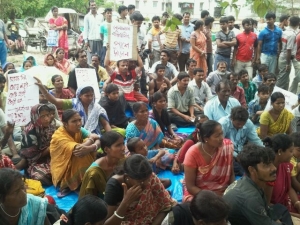
But this peaceful demonstration was broken by the Kolkata police, who alleged the assembly as ‘illegal’ despite having granted prior permission for the same. 69 protesters of ‘Uchchhed Pratirodh Committee’ (Anti-eviction Committee of Nonadanga) were arrested and transported to Lalbazar police station. A nine-year-old girl child, Manika Kumari, daughter of Dilip Shaw, was in the lock-up for nine hours; Manika Kumari’s detention violated the Juvenile Justice (Care & Protection of Children) Act, which starkly reminds us of Payel Bagh’s case during the Singur unrest. The police deliberately did not, moreover, issue any Memos of Arrest—another violation of legal procedures.
Continuing with the high-handedness, cases under section 151 of the IPC were slapped on the detainees. During the evening of April 8, all the arrested persons were released on PR bond in the presence of members of the Association for the Protection of Democratic Rights (APDR) and other activists through the rear gate of Lalbazar police station. However, seven democratic rights activists were not released and remained in confinement, i.e., Debolina Chakraborty, Shamik Chakraborty, Manas Chatterjee , Debjani Ghosh, Siddhartha Gupta, Partho Sarathi Ray and Abhijnan Sarkar. They have been falsely charged with a number of non-bailable criminal cases. When the released activists and others assembled at Lalbazar became agitated at this unexpected development, all were forced to flee by a huge contingent of aggressive police. APDR members proceeded to the central gate of Lalbazar to speak to the officer in charge and lodged a protest. According to the officers on duty, the seven activists had been charged under various sections including 353, 332, 141, 143, 148 and 149 of the IPC and were to be produced at the Additional Chief Judicial Magistrate (ACJM) court, Alipore, on 9 April, 2012.
The seven activists were remanded to police custody till April 12 by the ACJM court in Alipore Court after the state counsel raised the bogey of Maoist links and alleged that the activists were involved in ‘stockpiling of arms, ammunition and explosives at Nonadanga’. On the same day, a protest rally under the banner of ‘Uchchhed Pratirodh Committee’ (Anti-eviction Committee, a common platform of the evictees of Nonadanga and various mass organizations), demanding rehabilitation for dispossessed people in Nonadanga and release of the arrested protesters was to be held at 1 pm from College Square to Writers’ Building. But police prevented the rally from starting and arrested 50 men, 36 women and 4 children accompanying their mothers. They were taken away by 5 prison vans. The rest of the protesters started sit-in there in College Square, in front of the Vidyasagar statue and a gathering began. Engaging in activities like sloganeering, addressing the local people, etc., the College Street protest continued till 8:30pm, until those 86 arrested men and women were released on bail. The saga of state repression continued on April 10 with APDR activists reporting that the police did not allow family members to meet the seven detained activists. While repression continues in full force, the slum area is also being prepared for the real estate sharks waiting for the people to be “cleared off”. It has been reported that the police undertook a “land survey” on April 10 and declared that they would start fencing off the area from the next day. The evicted slum dwellers, who have living in the nearby fields for the past week, have decided to sit on a hunger strike to protest this move by the authorities.
Meanwhile, friends and supporters of Dr Partho Sarathi Ray have launched a campaign for his release. The following statement gives the details:
Dear Friends,
We are writing to bring to your attention the illegal detention of our colleague, Dr. Partho Sarothi Ray by the Kolkata Police. While participating in a peaceful protest against the eviction of slum dwellers of the Nonadanga area of East Kolkata, Partho along with 68 others including several women and one 9 year old girl was picked up by the Kolkata police near Ruby hospital crossing on Sunday, April 8, 2012. This happened despite the fact that prior permission for carrying out the peaceful protest was granted by the Kolkata police. That same evening, the police released 62 of the 69 people arrested but detained 7 including Partho. Various charges were laid against Partho (and the remaining 6 people detained) for activities allegedly undertaken on April 4 (Wednesday) during which the police resorted to lathi charge on women and children and other brutal tactics to break up a similar protest. Partho was not even present at the site of the protest on April 4 and there is documentary evidence of his presence in IISER, Kolkata (Mohanpur Campus, Nadia, West Bengal) on that day where he participated in a faculty meeting of the Dept. of Biological Sciences, interacted with colleagues and students and stayed overnight at the institute guest house.
Subsequently, during a farcical police court hearing on April 9 held at Alipore court, Kolkata, Partho along with others was remanded to police custody till April 12, 2012. A sessions court on April 12, 2012 remanded the seven detained activists to jail custody until April 26th. Some of the charges laid against Partho and 6 others detained are serious falling under sections 353 (assault on public servant), 332 (voluntarily causing hurt to public servant), 141 (unlawful assembly), 143 (punishment), 149 (common objective of disruption). There is some confusion regarding the number and nature of charges laid since the lists obtained from different sources do not match. In asking for the continued detention of these 7 individuals, the government lawyers made the absurd argument that these people, involved in a peaceful protest for which prior permission was given by the police, had potential Maoist links and it is therefore necessary to keep them in police custody to get “information” about “possible stockpiling of arms and explosives” in Nonadanga. This chilling message reveals the sinister design of the police and the West Bengal government and raises serious concerns for the safety and well-being of Partho and others currently in police
custody. It is therefore essential that we, members of the Indian academic community vociferously condemn the illegal detention of our colleague, a reputed scientist, under false charges and raise awareness so that pressure may be brought on the government to quickly release Partho and remove all the fabricated charges laid against him by the police. Friends in the media can help publicize the issue.
You can also help by signing online petitions here:
Release activists arrested for protesting Nonadanga
www.change.org
Aruna Roy and the MKSS have also sent the following statement in solidarity with Partho Ray and others arrested by the Westy Bengal government:
Dear friends,
An eminent scientist Partha Roy, faculty at IISER Kolkata, an alumnus of IISc and a member of Sanhati, a web paper which reports on democratic and human rights issues, was reporting on a protest against slum clearance in Kolkatta on the 8th of April. He and six others have been booked under sections 143, 149, 332, 341, 342, 353 of the IPC and have been detained unfairly for alleged participation in a protest which took place on the 4th( details in the petition). As it so happened Partha Roy was not there that day, but in the Institute and there is documentary evidence and testimony to prove this.
Despite all this being presented at court he was refused bail by a Kolkata court on the 9th. Intimidation, illegalities and abuse of
power must be questioned and stopped .
In solidarity.
Aruna
Aruna Roy , Nikhil Dey, Shankar Singh and the MKSS
Goons attack rights rally but cops arrest 6 activists
Six activists were arrested for "taking out the procession without permission", but not one of the attackers was identified or nabbed. The Association for Protection of Democratic Rights - which organized the rally to protest against the arrest of seven persons during the April 9 Nonadanga agitation - alleged the attackers wereTrinamool Congress goons. Among those arrested is APDR assistant secretary Rangta Munshi.
The incident sparked outrage among the intelligentsia. Actor Koushik Sen, Trinamool MP and singer Kabir Suman and educationist Sunanda Sanyal (who used to share the stage withMamata Banerjee not so long ago) held a meeting in the evening to criticize the government.APDR had planned to march from Hazra to Alipore court. Some 30 of them gathered in front of Jatin Das Park. APDR general secretary Debaprasad Roychowdhury said: "We were preparing for the rally when the police arrived and asked us to cancel it. We tried to reason with the officers." APDR member Chandan Pramanik said that transport minister Madan Mitra visited the place and spoke to the police.
"Suddenly a group of youths loitering near the auto stand rushed towards us and pounced on Debaprasad and the others," said Munshi. Fists, blows and abuses rained down on the activists, alleged Sudipta Sen, APDR assistant secretary. APDR's Sujato Bhadra alleged that some Trinamool members assaulted the APDR activists as the police force (led by ACP, south, Tapas Bose) stood like "silent spectators". "Police did not bother to arrest the attackers but they started dragging us to the prison van and finally arrested six of us," said Pramanik. Sen, too, alleged that the attackers were Trinamool-backed hoodlums and it was a pre-planned assault. DCP (south) D P Singh said he is yet to get a complaint in this regard.
"Should they make one it will be investigated," he said. A group of intellectuals held a meeting at Bangla Academy in the evening to condemn the attack and the police action. "We are gradually losing trust on the government. It is trying to suppress democratic rights.
I condemn the attack on the rights activists. The government is seizing all rights of expression. Police are not allowing rallies and meetings," Sen said.Kabir Suman was also vocal against the eviction at Nonadanga.
"In 2006, I had joined Mamata's anti-eviction movement. I was with her in Nandigram. Now, I am once again fighting for the anti-eviction movement. But now Mamata is not with me," said Suman, who claimed that several Trinamool leaders are also against such government decisions. Former Naxalite leader Asim Chatterjee strongly criticized Mamata Banerjee.
"Mamata has become the chief minister by riding on the anti-eviction movement. Now she herself has started evicting people," said Asim. Several activists like Meeratun Nahar and Jaya Mitra joined the meeting.
Now, Mamata faces protests over land for rail projects
http://www.tehelka.com/story_main48.asp?filename=Ne010111Now_Mamata.asp
BY PARTHA DASGUPTA
|

AS THE West Bengal Assembly election draws near, Trinamool Congress chief and Railway Minister Mamata Banerjee’s political plank — forcible land acquisition — is being thrown back at her. That too, relating to railway projects that have been in the incubator for decades.
Villagers are opposing a railway project on 630 acres of farmland in Sankrail, Howrah district, acquired from 400-odd families in the early 1980s. On the morning of 7 December, when railway contractors tried to start landfill work at Bhagabatipur between Sankrail and Abada railway stations, they were driven away by villagers cutting across party lines. This is where a Diesel Multiple Unit (DMU) coach factory is to be built with Rs. 263 crore sanctioned in the last rail budget.
Although the Trinamool chief blamed the stir on ‘outsiders’, clearly hinting at the CPM, the 300-odd men who stalled the landfill were brought together by the Sankrail Block Krishijomi Rokkha Committee led by local TMC leaders Ashis Malik, Pradip Bhuniya and Bonhisikha Das.
But local MLA Sheetal Sardar, also of the TMC, disagrees: “The CPM has conspired to stall the work for the factory. We are in close touch with the authorities regarding the demands of the local people and hope to restore construction work in a couple of days.”
Asked for her reaction, Mamata waxed philosophical: “It is for the locals to decide whether they want the factory. I meant well and got sanction for the project as the land was unutilised for 25 years.”
When the land was acquired by the state government in 1981-84 at the behest of the then Union minister Priya Ranjan Dasmunshi, the going rate for compensation was Rs. 3,200 a bigha.
The then Railway Minister Madhavrao Scindia offered a job to one member of every family that parted with its land. However, after a couple of years, the railways discontinued the project of shifting the Shalimar yard to Sankrail, thereby jeopardising the livelihood of a couple of thousand people.
Ironically, the TMC-led Singur land agitation raised farmers’ expectations and they are now demanding a ‘fresh and just’ compensation for their land, which at present market rates is a whopping Rs. 60 lakh per bigha.
The CPM is clearly using the land card just as the TMC did in the past. Debu Malik, member of the Sankrail-1 local committee of the CPM, who lost his land to the project, said, “We have four demands. We need to know exactly what is going to come up here. The railways must stick to its promise of one job for every family. The farmers must be paid compensation at the going market rates and locals must be engaged in any construction work that happens here.”
|

The TMC chief, referring to the case filed for higher compensation, retorted, “We are not Tata or Birla. It is going to be a railway project. I am sympathetic to the cause of the locals and will go by the verdict of the court.”
But it’s not just Sankrail. There are local protests also in the north Bengal commercial town of Siliguri, a left bastion ruled by Municipal Affairs and Urban Development and Town Planning Minister and CPM strongman Ashok Bhattacharya. The construction of the northeastern head office of the Railway Recruitment Board on a popular tennis ground has run into rough weather following protests by the SFI, the students wing of the CPM. Bhattacharya wrote to Mamata on 15 December urging her to halt work.
THE LETTER says this ground has ‘transcended’ beyond a mere playground to a ‘heritage’ ground hosting big cultural meets, and is the ‘green heart’ of the town. It also expresses concern about the possible eviction of the slum dwellers on its periphery, referring to a representation from the Siliguri Safaai Mazdoor (Scavengers) Welfare Association.
|
Bhattacharya, the selfstyled ‘chief minister of north Bengal’ has urged the railway minister to “refrain” from constructing the building on humanitarian grounds.
However, the biggest land tussle is at Dankuni, 15 km west of Kolkata, where the department of fisheries filed an FIR against the railways on 16 December for allegedly filling up three fishing ponds measuring 75 acres to build its dedicated freight corridor (DFC). The corridor runs through 39,000 acres.
Now, Fisheries Minister Kiranmoy Nanda of the Socialist Party is in Mamata’s line of fire. She has accused him of pleading with her for an election ticket. “It is all a part of a bigger conspiracy being hatched by the CPM to scuttle development projects for the state,” she said.
It will be interesting to see how Mamata handles the boomeranging of her strongest political weapon — forcible land acquisition — in the run-up to the polls.
partha@tehelka.com
Wednesday, July 28, 2010
Running out of steam
http://kashmir-hr.blogspot.com/2010/07/running-out-of-steam.html
Soumitra Das
Journalism is not about patriotism. It is not about ‘my country right or wrong’. Journalism is about the Truth. In India, however, far too often a journalist’s first commitment is to his country rather than to the truth. Nowhere is this more evident than in our reportage on Kashmir and Pakistan. To talk about Kashmir first, we are in complete denial, we toe the government’s line unquestioningly: that everything in Kashmir would be hunky-dory if Pakistan stopped meddling; that Kashmir is actually madly in love with the Indian Army and it is only Pakistan which is holding Kashmiris back from expressing their true feelings about the army, the paramilitary forces and the J&K Police in good measure; that India has done nothing to deserve the violence and turbulence in that state; that the stone-pelters are just paid agents of the Lashkar-e-Tayyeba.
What is the truth? The truth could be that many Kashmiris are sick and tired of the Indian security forces; the truth could be that Kashmiris are looking for deliverance from the cycle of brutality in which they are caught. The truth could be that India had for years foisted corrupt and venal regimes in Srinagar through rigging and other acts of skullduggery. The truth could be that India had a chance to redeem itself when it brought in Sheikh Abdullah as chief minister of the state, but apart from fostering yet another political dynasty, the Abdullahs have had little impact on the climate of political feeling in the state. The truth could be that the stone pelters are the vanguard of a ‘revolution’ whose immediate political expression is the rejection of India and everything that India has come to represent in Kashmir.
As far as Pakistan is concerned, our media are even more slavishly patriotic. All the usual clichés and stereotypes are summoned whenever our journalists and intellectuals write on the subject. Pakistan is a rogue nation; it is a failed State; it is almost a criminal enterprise; its democracy is a sham...
Everything we say about Pakistan speaks of our hatred and resentment against the country. And yet, we see that Pakistan does not disappear from the map of the world and definitely won’t in a hurry. The Inter-Services Intelligence (ISI) may not be accountable, but how accountable is India’s Research and Analysis Wing (R&AW) and the Intelligence Bureau?
It’s also the naivete of it all. I remember a journalist on national TV saying, “We (India) are better than them (Pakistan).” What does that mean? That Pakistan is an Islamic republic and India, even with its pogroms against Sikhs in 1984 Delhi and against Muslims in 2002 Gujarat is a shining example of democracy? It is India, if my figures are right, that has more than 50 per cent of its children suffering from various effects of malnourishment. India’s regular free-and-fair elections may be the only thing that should genuinely make us proud as citizens.
History has been kind to us. It has provided us with a stick with which to beat Pakistan: cross-border terrorism. So, we can use it as a pretext for not talking about Kashmir where our position is weak. Take the ruckus over Jamaat-ud-Dawa chief Hafeez Sayeed. We want him gagged, arrested, tried and, ideally, executed, no matter what the legal position might be in Pakistan. We insist that Pakistan knows everything about Sayeed’s involvement in 26/11 and that Pakistan is resorting to lies and deception to evade taking responsibility. However, now, according to Home Secretary G.K. Pillai’s recent statement, it’s not Sayeed but the ISI “from start to finish”. What is germane is that no court in the world will convict a mass murderer only on the basis of what two major felons have to say about him. Ajmal Kasab’s and David Headley’s statements need corroboration.
There might be another lull in Kashmir, but this storm will continue to rage as long as the security forces continue to treat the local population the way they do. And the media continue to mix up their job of documenting ‘what is’ with ‘what they want things to be’.
Soumitro Das is a Kolkata-based writer
Thursday, July 15, 2010
An Appeal to join the Candle Light Protest in Kolkata from Concerned Citizens for Kashmir
http://www.facebook.com/notifications.php#!/event.php?eid=129173233791446
Tufail Mattoo (17)
Javid Ahmad Maila (18)
Shakeel Ahmad Ganai (14)
Firdous Ahmad Kakroo (17)
Asif Hassan Rather (9)
Ishteyaque Ahmad Khanday (15)
Imtiyaz Ahmad Itoo (17)
Muzaffar Ahmad Bhat (17)
Abrar Ahmad (17)
These are some of the twenty or so civilians killed by the security forces in the past month. The home minister has come out with statements like: “Parents should ensure that their children remain indoors. It is the responsibility of parents,” He further said that the purpose of moving in the Army was to “serve as a deterrent.” The Army would be in Kashmir “as long as it is necessary” to deal with the situation there. Fingers have been pointed at terrorist groups as well as the half-hearted attempts of the ruling NC state government to control the situation. But it is increasingly clear that spaces for civil dissent in Kashmir are few and continually shrinking. The armed forces have been used to crush all forms of civilian dissent in Kashmir and the protests and protesters in the valley are always criminalised more than anywhere else in the country.
No one from the central government has come out with a statement expressing grief at the loss of so many young lives and consoling the bereaved families. And all the while the civilian death-toll is mounting and will continue to do so as long as the Armed Forces (Jammu and Kashmir) Special Powers Act, 1990 (AFSPA)—which gives army officers the power to open fire on protesters and anyone else they decide is a potential lawbreaker whilst granting all personnel impunity from prosecution under civil law—remains in force in Kashmir.
Whatever our separate and individual takes on azaadi and armed insurgency, there cannot be any doubt that these killings of unarmed civilians—mostly angry teenagers—by the armed forces in Kashmir are gross violations of human rights and civil liberties. We must come together to
1. express our solidarity with the families of those who have been killed in the recent events and also with those who are protesting against the continued presence and the misconducts of the armed forces in the valley
2. strongly condemn the violence and the role of the security forces
3. insist that the Government of India and the state government take immediate action to prevent further loss of life and property and initiate an impartial investigation into the recent killings
4. demand the immediate repeal of the Armed Forces (Jammu and Kashmir) Special Powers Act, 1990 (AFSPA)
5. demand immediate steps for the gradual demilitarization of the valley with troops confined to the border areas
A candle light protest will be held on July 24, 2010 in front of Academy of Fine Arts between 5pm and 8 pm to protest and denounce the killings and human rights violation in Kashmir in the past weeks. We invite you to come and join the vigil and voice your protest. Please forward this appeal to others. We are also sorry about crosspostings, if there are any.
We would also request you to get in touch with us by July 16, 2010 to let us know if you would like to support and participate in the vigil.
Thanks,
Aniruddha, Debjani, Madhura, Parjanya
(on behalf of Concerned Citizens for Kashmir)
About Concerned Citizens for Kashmir: We are a group of citizens who have come together to express our concern over the events in Kashmir and to express our solidarity with the people affected by the 20 years of conflict there. We have no affiliations to any other groups.
Thursday, July 8, 2010
Age of the stone wars in Kashmir
by Najib Mubarki
http://economictimes.indiatimes.com/Opinion/Comments--Analysis/Age-of-the-stone-wars-in-Kashmir/articleshow/6117640.cms?curpg=1
Insanity , Albert Einstein is supposed to have said, is doing the same thing over and over again and expecting different results. Apply that to Kashmir, and one doesn’t need to be an Einstein to figure out that he had got the equation right, again.
Leave, for argument’s sake, the baggage of history — of events from 1947: the accession , New Delhi’s political machinations , dismissed governments and rigged elections to the eruption of insurgency in 1989 — alone for a moment.
Let us assume , for that moment, that there is utter veracity in the official narrative that but for afew elements, who are being discredited, peace and harmony would be restored in the Valley.
Add the fact that armed militancy has been curbed significantly and a regime, elected via a surprisingly well-attended electoral exercise, is in charge.
Add also the statements emanating from the top echelons of both the central and state governments that there will be zero tolerance for human rights abuses. Given all that, if not perfect, things surely should have been better.
So why did the patent insanity of the last few days occur? Why does it happen repeatedly? Why did, day after day, the police and the CRPF shoot dead youngsters who were out protesting, rioting , against the deaths of the day before?
Most Kashmiris would answer that it is because they are under occupation, that the security forces behave as they do, use brute force, as they are the most acute and clear manifestation of the state people are alienated from and resisting. Or, at least, that Kashmiris live in a police state, where, literally, the law allows and supports torture , imprisonment and killings.
Official narrative, of course, invokes the Paksponsored terrorism theme. That, somehow , everything that doesn’t go according to plan in Kashmir has its roots across the border. The other way of looking at things would be to comprehend that essentially there are two competing nationalisms at work, at variance.
The Kashmiri version that seeks separation, exclusion, and the Indian version that insists on inclusion. And the violence that occurs is, therefore, squarely in the realm of the political. So, the broadest answer as to why those killings took place is that there is a denial of that political reality.
That, leaving Pakistan out entirely, New Delhi refuses to recognise and engage with the fact that it faces a political crisis in Kashmir.
Of course, elections were held, a democratic process seemingly restarted. But the mistake is to ignore both the deep roots of separatism and the complexity of political consciousness in Kashmir that separates issues of immediate governance, after years of debilitating strife, and that of the larger tehreek or ‘movement’ .
And the latter , clearly, has transformed. From a belief in armed insurgency, with the gradual realisation that it did not achieve its desired goals, to an incipient rights-and-protest based phase. And hartals , strikes and stone pelting are part of that.
Indeed, Kashmir has reverted to an older form of political expression. Stone-throwing or kani jung (stone war), has historically been a feature of Kashmir’s political battles.
That, if once, pelting stones and bricks were used in fights between different political factions within Kashmir, it now is emerging as the most violent way of showing resistance and dissent.
So, just who are these stonethrowers ? Just why are youngsters again and again coming out to pelt stones, even when they know they might be thrashed, detained or plain killed (as someone said, employing some Kashmiri black humour, the ages of those killed in the last few days, 17, 16, 14...9, read like the scores of a batsman in really bad form)?
The first thing to understand is that this is a generation that has seen and knows nothing else but violence. In a place steeped in political violence and brutal force, they are also a generation perhaps more politicised than those before.
And that is why they also represent, though it may come as a surprise, both an awareness of the failure of the separatist leadership as well as the apparent lack of need to have any leaders in order to protest.
Remember, it isn’t just the government that thinks them dangerous, many among the separatist leaders do too. And some have called them everything from miscreants to drug addicts to being Indian agents. But as part of wider Kashmiri society, they are one manifestation of the rage of having suffered incredible violence, of living lives of daily humiliation.
As part of Kashmiri society , they are aware of the doublespeak, the dissembling that is part of the official version of each killing, each act of violence. And they are part, most immediately visible right now, of the dissent against, the political response to, that violence.
And the governments’ response basically is to use force to contain that political crisis. But the crisis remains. Even in its instrumentalities . Talk of standard operating procedures, for example, has no meaning for Kashmiris when live fire, tear gas shells, even rubber bullets are aimed at the head or chest, as the injuries of the dead reveal.
There can, again to speak of an instrumentality , be no meeting point between a CM who lauds a paramilitary force which, even as it supposedly is exercising restraint , kills daily, barges into homes, shatters windows and thrashes people.
There can be no greater absurdity that while that elected state government endorses using force, the army chief speaks of the need to now use politics to deal with the situation.
It is evident that a bout of conflict subsides after a peak, only to erupt again over the next incident, the next event. And Kashmir is now in a dangerous zone where more suppression, mere reliance on using state force, could fuel the rage into unpredictable territory.
Using absurd phrases like agitational terrorism or nonviolent terrorism or perpetually seeking to link protests over killings to Pakistan or Islamist groups only widens the rupture between what should be done and what is.
Allowing a political process, after all, would also mean allowing those sections or leaders the state is averse to some space, allowing that dissent, those protests or marches, not trying to choke everything all the time. The only thing that can emerge in such a situation is other, more violent forms of that dissent.
The stone throwers are a reminder that there is no way out except engaging with that dissent in Kashmir. That without such an engagement, by only using force again and again, Kashmir will, to borrow the words of the Russian poet Arseny Tarkovsky , stay a place where destiny seems to shadow events like a madman with a razor in his hand.
Wednesday, July 7, 2010
Friday, March 26, 2010
Tetley’s Tata Tea Starving Indian Tea Workers into Submission
http://radicalnotes.com/journal/2009/11/12/tetleys-tata-tea-starving-indian-tea-workers-into-submission/
Tata, the transnational Indian conglomerate whose Tetley Group makes the world famous Tetley teas, has taken 6,500 people hostage through hunger. The hostages are nearly 1,000 tea plantation workers and their families on the Nowera Nuddy Tea Estate in West Bengal, India. Permanently living on the edge of hunger, the workers and their dependants are being pushed to the edge of starvation through an extended lock out which has deprived them of wages for all but two days since the beginning of August. The goal of this collective punishment is to starve the workers into renouncing their elementary human rights, including the right to protest extreme abuse and exploitation.
The hostage-taking began with a first lockout on August 10, when workers protested the abusive treatment of a 22 year-old tea garden worker who was denied maternity leave and forced to continue work as a tea plucker despite being 8 months pregnant. On August 9, Mrs Arti Oraon collapsed in the field and was brought to the hospital, on a tractor normally used for garbage, after the medical officer refused to make an ambulance available (he had proposed she be brought by bicycle). She was initially refused treatment, and only after her co-workers protested did she receive minimal care. Her treatment was inadequate and she had to be taken, in the same garbage tractor, to the local government hospital one hour away.
As news of her treatment spread, some 500 mostly female estate workers gathered in protest at the medical facility, demanding sanctions against the medical officer. Local management promised to meet with the workers, but on August 11 the management, along with the medical officer, left the estate and declared a lockout.
On August 27 an agreement was signed with three trade unions, representing some workers on the estate but not a majority, on reopening the garden. In the agreement, all workers’ wages for the lockout period were withheld. The agreement included a clause that a “domestic inquiry” (an internal, company-controlled investigation) would be conducted. The agreement was written in English, a language few if any of the workers understand.
The garden was reopened the following day, although workers were not informed of the conditions of the reopening. On September 8, management issued letters of suspension and ordered a domestic inquiry against eight workers.
None of the eight workers received a letter of notification. None of the eight had committed any act of violence or were involved in any illegal practice. These eight workers have been targeted because they are active in the garden campaigning for workers’ rights.
At a September 10 meeting, management told the workers that suspension letters had been issued in accordance with the August 27 agreement and that opening the garden depended on compliance with that agreement. In other words: agree to the suspensions or you’ll be locked-out again. Workers requested six days to respond to this ultimatum.
The ultimatum was a powerful one: tea garden wages are just 62.50 Indian rupees per day – the equivalent of USD 1.35 daily. One kilogram of the cheapest, poorest quality rice in the local market costs 20% of a worker’s daily wage. Tea workers permanently live on the edge of hunger. The loss of wages for even a few weeks can tip them into starvation.
Although wielding the weapon of hunger – with workers’ lives in the balance and the deadline to respond not yet expired – management on September 14 again left the plantation and implemented a lockout. This was the day workers were meant to receive their annual festival bonus, amounting to roughly two months wages. No bonus payments were made. Prior to the lockout, since the beginning of August workers have only received a wage payment amounting to two days work.
Following the closure, workers have sought to communicate with the management, requesting it to reopen the garden. The company has insisted that the garden will not be reopened and wages paid unless all workers accept the September 10 ultimatum to effectively sign off their right to protest abuses.
Tata Tea is a powerful global company; it’s wholly owned Tetley Tea is one of the world’s biggest-selling tea brands. Nowera Nuddy Tea Estate is owned by Amalgamated Plantations Private Limited, a company 49.98% owned by Tata Tea. Tata and Amalgamated share the same office in Kolkata, the capital of West Bengal. According to the Tata Tea 2009 annual report, Tata Tea Managing Director Percy T. Siganporia earns in a single day roughly 1,000 times the daily wage of a Nowera Nuddy worker – assuming that worker is paid .
Tea from Amalgamated Plantations’ tea estates goes into the famous Tetley Tea bags.
Tetley Tea is a member of the Ethical Tea Partnership (ETP), whose standard commits member companies to, among other requirements, ensure that there is no “harsh or inhumane treatment” of plantation workers and that “Workers should be paid at least monthly and should receive their pay on time.” The actual conditions on the Nowera Nuddy estate, where workers are being subjected to brutal collective punishment, could not be more remote from this CSR wish list.
Workers at the Nowera Nuddy Tea Estate have formed an Action Committee which has called for the immediate reopening of the garden, the withdrawal of the suspension letters and no recriminations against workers, back payment of wages and rations since 14 September, immediate payment of the annual festival bonus and a management apology to Mrs Arti Oraon.
You can support their struggle – CLICK HERE to tell Tata and Tetley Tea to stop starving workers now! You can also use the features provided on the Tetley Tea website to send the company a message, or use the freephone number provided to give them a call!
Courtesy: IUF-Uniting Food, Farm and Hotel Workers World-Wide
Wednesday, March 10, 2010
Irom Sharmila rearrested
http://www.hindu.com/2010/03/10/stories/2010031056141500.htm
IMPHAL: Irom Sharmila, who has been on a fast-unto-death since November 4, 2000 demanding the repeal of the Armed Forces (Special Powers) Act, 1958 (AFSPA) in Manipur, was rearrested on Tuesday, as she continued her fast despite being released by the court.
The Act, under which she was arrested (for attempt to commit suicide), does not permit the authorities to detain her for more than one year at one go.
She was released on Monday after she completed one year of detention. As her condition without medication and nose-feeding became precarious, the police rearrested her.
Sources said her condition was a cause of concern. All her organs were affected. She staggered out of J.N. Hospital, which was declared a sub-jail for her and went straight to the office of Save Sharmila Organisation nearby to continue her protest.
She told journalists that there was no question of her breaking the fast until the AFSPA was repealed. The misuse of its provisions resulted in people getting killed, and in excesses, she said.
Sharmila had rejected appeals from Prime Ministers, Presidents and other leaders in the past to break her fast. She only wanted to sleep on her ailing mother's lap at home, she said.
On November 4, 2000, some militants exploded a bomb near the airport here, as three vehicles of 8 Assam Rifles were passing by.
There was no casualty or damage to the vehicles.
However, the personnel allegedly rounded up 1o persons, who were standing in the bus-stand and working in their homes nearby and all were mowed down. In protest, Sharmila launched the fast.
Subscribe to:
Posts (Atom)
