http://www.telegraphindia.com/1120423/jsp/calcutta/story_15349523.jsp#.T5TZiPvhVzQ
Monday, April 23, 2012
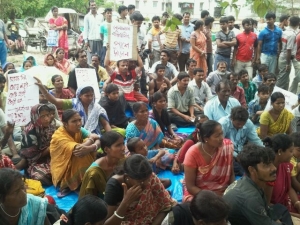
Eviction drive clears road for Bypass expansion, work picks up speed
http://www.telegraphindia.com/1120423/jsp/calcutta/story_15349523.jsp#.T5TZiPvhVzQ
Posted by Madhura at 3:29 PM 1 comments
Labels: Development in West Bengal, eviction, sanitization of urban spaces, Urban Development, Urban Poverty
Friday, April 13, 2012
Eviction of Slum Dwellers and Repression of Anti-Eviction Demonstrators in West Bengal
Selections of the original are published here. For the youtube link and rest of the report go here: http://kafila.org/2012/04/13/eviction-of-slum-dwellers-and-repression-of-anti-eviction-demonstrators-in-west-bengal/
Aditya Nigam
It is the same story once again. Cleaning up and beautification of cities in the clamour for urban space for consumption and the luxury of the rich. And as we have seen, it makes little difference whether the government/s are Leftist or Rightist, whether they claim to represent the oppressed poor or not. Thus, on 30th March, 2012 the TMC government forcefully evicted around 300 poor families from the Nonadanga slum area in South 24-Parganas, in the name of ‘development’ and ‘beautification’ of Kolkata. Their shanties were razed to ground by the Kolkata Metropolitan Development Authority. The homeless slum-dwellers have been staying in an open field and are facing constant police harassment. Despite these harsh conditions, they have refused to depart and are presently on hunger strike. Their demand has to date failed to draw any favourable attention from the government. This neglect comes on the heels of the Planning Commission agreeing to annual Bengal plan around 16 per cent more than last year’s.
But the neglect is not only economic : the state government has intensified its repressive tactics. On 4th April, 2012, the Kolkata police and a gang of ruffians who viciously lathi-charged the dispossessed as they organized a protest march to draw attention to their wretched condition. A large police force attacked the protesters including women and infants; there was not a single female constable in the posse. Rita Patra, a pregnant woman, was seriously injured in the lathi-charge. Ten persons, including a baby boy and two girls in their early twenties, were severely injured. To protest this police brutality, slum demolition and forcible eviction, a day long sit-in demonstration was scheduled at Ruby Crossing, E M Bypass of Kolkata, on 8th April, 2012.
But this peaceful demonstration was broken by the Kolkata police, who alleged the assembly as ‘illegal’ despite having granted prior permission for the same. 69 protesters of ‘Uchchhed Pratirodh Committee’ (Anti-eviction Committee of Nonadanga) were arrested and transported to Lalbazar police station. A nine-year-old girl child, Manika Kumari, daughter of Dilip Shaw, was in the lock-up for nine hours; Manika Kumari’s detention violated the Juvenile Justice (Care & Protection of Children) Act, which starkly reminds us of Payel Bagh’s case during the Singur unrest. The police deliberately did not, moreover, issue any Memos of Arrest—another violation of legal procedures.
Continuing with the high-handedness, cases under section 151 of the IPC were slapped on the detainees. During the evening of April 8, all the arrested persons were released on PR bond in the presence of members of the Association for the Protection of Democratic Rights (APDR) and other activists through the rear gate of Lalbazar police station. However, seven democratic rights activists were not released and remained in confinement, i.e., Debolina Chakraborty, Shamik Chakraborty, Manas Chatterjee , Debjani Ghosh, Siddhartha Gupta, Partho Sarathi Ray and Abhijnan Sarkar. They have been falsely charged with a number of non-bailable criminal cases. When the released activists and others assembled at Lalbazar became agitated at this unexpected development, all were forced to flee by a huge contingent of aggressive police. APDR members proceeded to the central gate of Lalbazar to speak to the officer in charge and lodged a protest. According to the officers on duty, the seven activists had been charged under various sections including 353, 332, 141, 143, 148 and 149 of the IPC and were to be produced at the Additional Chief Judicial Magistrate (ACJM) court, Alipore, on 9 April, 2012.
The seven activists were remanded to police custody till April 12 by the ACJM court in Alipore Court after the state counsel raised the bogey of Maoist links and alleged that the activists were involved in ‘stockpiling of arms, ammunition and explosives at Nonadanga’. On the same day, a protest rally under the banner of ‘Uchchhed Pratirodh Committee’ (Anti-eviction Committee, a common platform of the evictees of Nonadanga and various mass organizations), demanding rehabilitation for dispossessed people in Nonadanga and release of the arrested protesters was to be held at 1 pm from College Square to Writers’ Building. But police prevented the rally from starting and arrested 50 men, 36 women and 4 children accompanying their mothers. They were taken away by 5 prison vans. The rest of the protesters started sit-in there in College Square, in front of the Vidyasagar statue and a gathering began. Engaging in activities like sloganeering, addressing the local people, etc., the College Street protest continued till 8:30pm, until those 86 arrested men and women were released on bail. The saga of state repression continued on April 10 with APDR activists reporting that the police did not allow family members to meet the seven detained activists. While repression continues in full force, the slum area is also being prepared for the real estate sharks waiting for the people to be “cleared off”. It has been reported that the police undertook a “land survey” on April 10 and declared that they would start fencing off the area from the next day. The evicted slum dwellers, who have living in the nearby fields for the past week, have decided to sit on a hunger strike to protest this move by the authorities.
Meanwhile, friends and supporters of Dr Partho Sarathi Ray have launched a campaign for his release. The following statement gives the details:
Dear Friends,
We are writing to bring to your attention the illegal detention of our colleague, Dr. Partho Sarothi Ray by the Kolkata Police. While participating in a peaceful protest against the eviction of slum dwellers of the Nonadanga area of East Kolkata, Partho along with 68 others including several women and one 9 year old girl was picked up by the Kolkata police near Ruby hospital crossing on Sunday, April 8, 2012. This happened despite the fact that prior permission for carrying out the peaceful protest was granted by the Kolkata police. That same evening, the police released 62 of the 69 people arrested but detained 7 including Partho. Various charges were laid against Partho (and the remaining 6 people detained) for activities allegedly undertaken on April 4 (Wednesday) during which the police resorted to lathi charge on women and children and other brutal tactics to break up a similar protest. Partho was not even present at the site of the protest on April 4 and there is documentary evidence of his presence in IISER, Kolkata (Mohanpur Campus, Nadia, West Bengal) on that day where he participated in a faculty meeting of the Dept. of Biological Sciences, interacted with colleagues and students and stayed overnight at the institute guest house.
Subsequently, during a farcical police court hearing on April 9 held at Alipore court, Kolkata, Partho along with others was remanded to police custody till April 12, 2012. A sessions court on April 12, 2012 remanded the seven detained activists to jail custody until April 26th. Some of the charges laid against Partho and 6 others detained are serious falling under sections 353 (assault on public servant), 332 (voluntarily causing hurt to public servant), 141 (unlawful assembly), 143 (punishment), 149 (common objective of disruption). There is some confusion regarding the number and nature of charges laid since the lists obtained from different sources do not match. In asking for the continued detention of these 7 individuals, the government lawyers made the absurd argument that these people, involved in a peaceful protest for which prior permission was given by the police, had potential Maoist links and it is therefore necessary to keep them in police custody to get “information” about “possible stockpiling of arms and explosives” in Nonadanga. This chilling message reveals the sinister design of the police and the West Bengal government and raises serious concerns for the safety and well-being of Partho and others currently in police
custody. It is therefore essential that we, members of the Indian academic community vociferously condemn the illegal detention of our colleague, a reputed scientist, under false charges and raise awareness so that pressure may be brought on the government to quickly release Partho and remove all the fabricated charges laid against him by the police. Friends in the media can help publicize the issue.
You can also help by signing online petitions here:
Release activists arrested for protesting Nonadanga
www.change.org
Aruna Roy and the MKSS have also sent the following statement in solidarity with Partho Ray and others arrested by the Westy Bengal government:
Dear friends,
An eminent scientist Partha Roy, faculty at IISER Kolkata, an alumnus of IISc and a member of Sanhati, a web paper which reports on democratic and human rights issues, was reporting on a protest against slum clearance in Kolkatta on the 8th of April. He and six others have been booked under sections 143, 149, 332, 341, 342, 353 of the IPC and have been detained unfairly for alleged participation in a protest which took place on the 4th( details in the petition). As it so happened Partha Roy was not there that day, but in the Institute and there is documentary evidence and testimony to prove this.
Despite all this being presented at court he was refused bail by a Kolkata court on the 9th. Intimidation, illegalities and abuse of
power must be questioned and stopped .
In solidarity.
Aruna
Aruna Roy , Nikhil Dey, Shankar Singh and the MKSS
Posted by Madhura at 1:30 PM 1 comments
Labels: Aditya Nigam, Development in West Bengal, Didi's government, eviction, Letters and petitions, Protests, sanitization of urban spaces
Now, Mamata faces protests over land for rail projects
http://www.tehelka.com/story_main48.asp?filename=Ne010111Now_Mamata.asp
BY PARTHA DASGUPTA
|
AS THE West Bengal Assembly election draws near, Trinamool Congress chief and Railway Minister Mamata Banerjee’s political plank — forcible land acquisition — is being thrown back at her. That too, relating to railway projects that have been in the incubator for decades.
Villagers are opposing a railway project on 630 acres of farmland in Sankrail, Howrah district, acquired from 400-odd families in the early 1980s. On the morning of 7 December, when railway contractors tried to start landfill work at Bhagabatipur between Sankrail and Abada railway stations, they were driven away by villagers cutting across party lines. This is where a Diesel Multiple Unit (DMU) coach factory is to be built with Rs. 263 crore sanctioned in the last rail budget.
Although the Trinamool chief blamed the stir on ‘outsiders’, clearly hinting at the CPM, the 300-odd men who stalled the landfill were brought together by the Sankrail Block Krishijomi Rokkha Committee led by local TMC leaders Ashis Malik, Pradip Bhuniya and Bonhisikha Das.
But local MLA Sheetal Sardar, also of the TMC, disagrees: “The CPM has conspired to stall the work for the factory. We are in close touch with the authorities regarding the demands of the local people and hope to restore construction work in a couple of days.”
Asked for her reaction, Mamata waxed philosophical: “It is for the locals to decide whether they want the factory. I meant well and got sanction for the project as the land was unutilised for 25 years.”
When the land was acquired by the state government in 1981-84 at the behest of the then Union minister Priya Ranjan Dasmunshi, the going rate for compensation was Rs. 3,200 a bigha.
The then Railway Minister Madhavrao Scindia offered a job to one member of every family that parted with its land. However, after a couple of years, the railways discontinued the project of shifting the Shalimar yard to Sankrail, thereby jeopardising the livelihood of a couple of thousand people.
Ironically, the TMC-led Singur land agitation raised farmers’ expectations and they are now demanding a ‘fresh and just’ compensation for their land, which at present market rates is a whopping Rs. 60 lakh per bigha.
The CPM is clearly using the land card just as the TMC did in the past. Debu Malik, member of the Sankrail-1 local committee of the CPM, who lost his land to the project, said, “We have four demands. We need to know exactly what is going to come up here. The railways must stick to its promise of one job for every family. The farmers must be paid compensation at the going market rates and locals must be engaged in any construction work that happens here.”
|
The TMC chief, referring to the case filed for higher compensation, retorted, “We are not Tata or Birla. It is going to be a railway project. I am sympathetic to the cause of the locals and will go by the verdict of the court.”
But it’s not just Sankrail. There are local protests also in the north Bengal commercial town of Siliguri, a left bastion ruled by Municipal Affairs and Urban Development and Town Planning Minister and CPM strongman Ashok Bhattacharya. The construction of the northeastern head office of the Railway Recruitment Board on a popular tennis ground has run into rough weather following protests by the SFI, the students wing of the CPM. Bhattacharya wrote to Mamata on 15 December urging her to halt work.
THE LETTER says this ground has ‘transcended’ beyond a mere playground to a ‘heritage’ ground hosting big cultural meets, and is the ‘green heart’ of the town. It also expresses concern about the possible eviction of the slum dwellers on its periphery, referring to a representation from the Siliguri Safaai Mazdoor (Scavengers) Welfare Association.
|
Bhattacharya, the selfstyled ‘chief minister of north Bengal’ has urged the railway minister to “refrain” from constructing the building on humanitarian grounds.
However, the biggest land tussle is at Dankuni, 15 km west of Kolkata, where the department of fisheries filed an FIR against the railways on 16 December for allegedly filling up three fishing ponds measuring 75 acres to build its dedicated freight corridor (DFC). The corridor runs through 39,000 acres.
Now, Fisheries Minister Kiranmoy Nanda of the Socialist Party is in Mamata’s line of fire. She has accused him of pleading with her for an election ticket. “It is all a part of a bigger conspiracy being hatched by the CPM to scuttle development projects for the state,” she said.
It will be interesting to see how Mamata handles the boomeranging of her strongest political weapon — forcible land acquisition — in the run-up to the polls.
partha@tehelka.com
Posted by Madhura at 1:23 PM 0 comments
Labels: Development in West Bengal, Didi's government, Land Acquisition, Protests
Sunday, May 22, 2011
LA NUIT BENGAL
The Telegraph, Editorial
The wise believe that everyone has two countries — France and her own. It is a relief to realize that the chief minister of West Bengal, the redoubtable Mamata Banerjee, is not an exception to this sage generalization. Her cabinet, announced after much drama very early on Saturday morning, will bring to mind the old French saying, “Plus ça change, plus c’est la même chose.’’ (“The more things change, the more they stay the same.’’) Change is, paradoxically, the guarantee of continuity. Ms Banerjee, it may be recalled despite the euphoria, had promised a small and compact cabinet. But she announced that her government would have 44 ministers. This is exactly the number her predecessor had in his cabinet. Under the existing law, West Bengal can only have 44 ministers since the upper limit for the number of ministers is 15 per cent of the total strength of the legislative assembly. Maximum leaders thus form maximum cabinets. Ms Banerjee has kept up with her rival. At the height of the Sino-Soviet dispute, the Chinese increased the alcohol content of the local vodka by a full percentage point to keep up with the Russians. Ms Banerjee has demonstrated that she is second to none in keeping up with the comrades. By forming a large cabinet, Ms Banerjee has violated a very elementary principle. What is good politics is not necessarily good governance. Even its critics will be forced to admit that the Left was good in politics, otherwise it could not have been elected seven times in a row. But the Left also ran an incompetent government, in fact, one of the worst in India. This resulted in West Bengal’s humiliating decline in all spheres. The point can be illustrated with a different example. The creation of numerical quotas through reservations makes for good politics as it brings electoral dividends, but it is certainly not good governance as it reduces the society’s and the country’s dependence on merit and competence. The largeness of Ms Banerjee’s cabinet is directly related to the largeness of her electoral success. Her triumph brings with it too many winners and too many expectations. To meet these expectations, she has, like her predecessor, chosen to address the demands of her party. Her party is only one of the stakeholders in the making of West Bengal. There are other stakeholders: most notably the people of the state. She has put the interests of one group of stakeholders above the others. This is the downside of a bloated victory. It has resulted in a bloated government. She would do well to remember that both Rajiv Gandhi and Buddhadeb Bhattacharjee had massive mandates that led to very high expectations, even outside the party. By failing to meet these expectations through good governance, they lost in subsequent elections. If Ms Banerjee overlooks these lessons, Bengal will not emerge from darkness. |
Posted by Madhura at 11:10 AM 1 comments
Labels: Development in West Bengal, Editorial, The Telegraph and Anandabazar Patrika, TMC
Monday, April 11, 2011
Buddhadeb promises industry at Singur
http://www.hindu.com/2011/04/11/stories/2011041156421200.htm
Special Correspondent

West Bengal Chief Minister Buddhadeb Bhattacharjee being greeted by an elderly woman during an election campaign meeting in Kolkata on Sunday.
KOLKATA: Reasserting the Left Front government's commitment to industrialisation in West Bengal for opening up job opportunities, Chief Minister Buddhadeb Bhattacharjee vowed on Sunday to set up industry at Singur from where the Tata Motors' small car project was relocated in October, 2008 in the face of a prolonged agitation led by the Trinamool Congress.
Addressing a meeting of Left workers in the Jadavpur area, from where he is seeking re-election to the Assembly, Mr. Bhattacharjee said the relocation of the Nano project had been costly for the State, but “that would not stop the setting up of factories in West Bengal.”
“When the eighth Left Front government takes over I will set up a factory at Singur which will be among the largest in the State,” he said.
“We will then see if they [the Trinamool] have the courage to resist it,” he said, while asserting that the next Left Front government would not tolerate moves to obstruct the setting up of industry.
Food security
Mr. Bhattacharjee reiterated that the Left Front government would continue with its work towards consolidating the agricultural successes achieved in the past and ensuring food security for all, even as it took forward its plans for more industrial growth.
He pointed out that his government had made no mistake in initiating the industrialisation drive which was essential for the State. Nearly 27 lakh youth were studying in various educational institutions in the State and they expect to be employed. This was only possible with the setting up of more factories.
No child's play
The Chief Minister, who has been ridiculing the call for “change” by the Opposition, said it was not “child's play.” People were well aware who would take the State forward and know which political dispensation, if it came to power, would spell doom for West Bengal.
Mr. Bhattacharjee, travelling in an open-hooded jeep, waved out at people lining the streets and shook hands with some, even as hundreds, holding aloft flags of the Communist Party of India (Marxist) and chanting slogans in support of him and the Left Front, marched down the roads and lanes criss-crossing the Jadvapur area in the southern fringes of the city.
He spent several hours in the morning and evening on the campaign trail there.
In the Thakurpukur-Behala area, a massive ‘padayatra' was taken out by Left Front workers and supporters in which Biman Bose, chairman of the Left Front committee and the State secretary of the CPI(M) participated.
Posted by Madhura at 11:54 AM 0 comments
Labels: Assembly Elections 2011, Buddhadev Bhattacharya, Development in West Bengal, Food Security, Industrialisation vs Agriculture, ingur
Tuesday, January 25, 2011
The New Cellu-lar Jail
The writers are activists based in Chennai working on issues of land, labour, industry and SEZs.
Sriperumbudur grabbed media attention in 1991 when former Prime Minister Mr Rajiv Gandhi was assassinated during an election rally. Since then, this nondescript little village-town in west Chennai, dotted with paddy fields and large expanses of natural water-bodies, has transformed itself into a little ‘Shenzen’- world’s largest special economic zone in Southern China, which churns out one out of every eight mobile handsets sold anywhere in the world. Slated to attract investments worth $4 billion in electronics and automobile manufacturing, Sriperumbudur is now home to the largest mobile handset making factory of Nokia, a Finnish company that can churn out 7.5 lakhs handsets a day. This town and its neighbouring region is also known as the Detroit of India, churning around 12,80,000 cars every year. With a booming manufacturing industry and a promise of 2 lakhs jobs, Sriperumbudur is touted as the jewel in the industrial crown of Tamil Nadu. But of recent this seemingly success story has turned a little sour.
The jewel has a tarnish which the state government does not know how to hide anymore: growing labour unrest, demand for unions, and frequent strikes.The state’s response has been swift—arrest the ‘erring’ workers and bust the unions. And it does that quite cleverly. It’s done as neatly as is the ‘clean’ image of these sophisticated modern industries, barring a few instances where police has lathi charged the workers.
“Their modus operandi is to form a party affiliated union, broker deal with the management, get the workers back to work and whoever does not fall in line, have them arrested or have their jobs terminated. Pretty neat. ”, alleged A Soundarajan, state general secretary of Centre for Indian Trade Union (CITU). Soundarajan and his colleagues should know better. They are out on bail after being incarcerated for 15 days in Vellore Central Jail in October. Their crime: daring to form a union and organising a strike in Foxconn India Limited, a Taiwanese MNCs. While the CITU leaders and workers were in jail, Dravida Munnetra Kazhagam (DMK)-affiliated Labour Progressive Federation (LPF) union, which also has a union in Foxconn, brokered a ‘long term wage settlement’ with the Foxconn management, thereby compromising on the workers’ demands.
“This is a repeat of what happened in the 1960s. At that time, the congress-led government did the same thing during the strikes in MRF, Ashok Leyland, TI Cycles. Used party affiliated union to broker compromised deals to break genuine worker’s strikes”, said Soundarajan. For about 60 days since 24th September, the young workforce of Foxconn India, a special economic zone (SEZ) and a key supplier of electronic components to Nokia SEZ, were sitting on strike demanding better wages, good service conditions and recognition of their trade union . “We get very low wages. Trained permanent employees who have been with the company for more than 3 years get only about Rs 4500 per month,” said Dinesh of the CITU-affiliated Foxconn India Thozhilalar Sangam who is one of the 23 workers suspended for engaging in unionizing activities. “We have rejected the wage agreement reached between the management and Foxconn India Thozhilalar Munnetra Sangam (LPF). They did it behind our backs”, added Dinesh.
As per the ‘wage settlement’ published on 12th October by Foxconn management, workers will get a maximum gross salary of Rs 9500 per month staggered over a period of three years and starting with Rs 7830. “We had demanded Rs 10,000 per month as gross salary for the permanent workers, but the LPF union cut a deal for lower wages with the management and settled the dispute. The state government actively participated in this process through the labour commissioner’s office,” informed Soundarajan. “Things get desperate when the strike goes on for so long. We had so many rounds of talks with the labour commissioner, besides meeting the ministers, including the Chief Minister. But nothing came out of it. Management did not even reinstate the suspended workers. It is specifically targeting workers affiliated with our union”. The workers allege that the management is demanding a written undertaking from the suspended workers ‘to not join the union’ before they can be reinstated.
Unlike in Maharashtra and West Bengal, there is no law in Tamil Nadu which makes it mandatory for the private companies to recognize trade unions. Foxconn workers were forced to call off their two-month-long spirited strike, their demands unmet and 24 of their colleagues still suspended from job. Similar strikes were witnessed recently in a Chinese SEZ called Build Your Dream (BYD Co) in Sriperumbudur. On 21st October, 4000 permanent and contract workers of BYD Co went on strike. They were demanding 8-hour work shift, permanent employment, better amenities and right to associate. The same day BYD management and officials from the State Labour Department assured the striking workers that their demands will be ‘negotiated’. Workers resumed work the next day. But the management did not show any intention to fulfill its promise.
“Instead they abused and mentally tortured one of our workers named Prem. They accused him of organising the strike and trying to unionise. Prem felt so intimidated that he tried to commit suicide by consuming two bottles of Iso Propyl Alcohol. Another contract worker was also arbitrarily targeted and sacked by the management,” lamented Prema, a worker from BYD Co. Agitated BYD workers resumed their strike on 28th Oct and continued stay-in-strike (inside the factory) till 30th October. They were later forced to shift the strike outside the factory gates by the police. On 1st Nov’2010, the management stuck a ‘notice’ on the factory gates, suspending 437 workers. The notice further stated that the factory was “an SEZ” and “a Public Utility Facility under the SEZ Act”. Therefore under “section 22 of Industrial Disputes Act”, the ongoing strike by the workers was being declared “illegal”. It also made clear that during the lockout period workers will be treated in “no work no pay mode”. Unmindful of what the notice said, the workers, mostly young women in their 20s, continued to strike. But at the end of three weeks of strike, the workers were left with little choice but to go back to work.
Management has now issued them new IDs thus effectively obliterating their previous work records. Many of them hail from faraway districts, are first-generation literates and the only ones in their families with a steady income. “DMK government is compromising workers’ right in its greed to attract foreign investment. They are making the workers desperate. In the 70s’ Chief Minister M. Karunanidhi had declared that the government would crush the workers’ agitations with an iron hand. He is doing it again now”, recalled Soundarajan.In the past one year, Sriperumbudur, Orgadam, and Irrungattakottai have seen a number of labour strikes. In most cases, the demands have been more or less similar: better wages, better service conditions, safety and basic facilities at work place, and right to unionise. In June this year, workers of Hyundai Motor India went on a flash strike demanding that the management reinstate 67 of their co-workers who had been dismissed for demanding the recognition of trade union.
In a similar case, employees of Nokia India also resorted to strike early this year demanding wage revision. In August this year, 28, workers of Sanmina went on a 2-day strike for similar reasons but which was crushed by the police by threatening arrest if the workers persisted. As per state labour department’s policy note (Budget Performance 2010-‘11), between Jan’ 2009 and Mar’ 2010, the state had witnessed 72 strikes and lock outs, out of which 40% were related to wages.Tamil Nadu may eventually realise its dream of becoming an industrialised state, but not before thousands of young workers are consigned to a life of discontent, despair and disillusionment.
Posted by Madhura at 9:06 AM 0 comments
Labels: Development in West Bengal, Economic Growth and Development, SEZ, www.kafila.org
Friday, January 14, 2011
Full circle? Nandigram farmers now at receiving end of Mamata men Read more: Full circle? Nandigram farmers now at receiving end of Mamata men - The
NANDIGRAM: Those who took up cudgels against forcible land acquisition at West Bengal's Nandigram in 2007 and turned the tide against the ruling CPM, emerged as tormentors on Wednesday. Trinamool Congress members attacked people who protested against land acquisition for railways on an 18km stretch from Nandigram to Deshpran.
Wielding lathis, the Trinamool members pounced on agitators in front of Gholpukur primary school, leaving five injured. One of them had to be taken to Reyapara hospital with critical wounds. Mahadeb Bag, sabhapati of the Trinamool-run Nandigram Panchayat Samiti, led the charge. Those protesting against land acquisition by the railways belonged to Annadata Bhumi Raksha Committee. They demanded the railways should come clear on the compensation price and its promise for railway jobs to each of the families whose land would be acquired.
"It was a peaceful agitation where those who feared losing land were trying to send out a message to Trinamool chief," said Dilip Guchhait, secretary of the committee. Trouble broke out when local Trinamool leaders called party supporters and began shouting slogans against the agitators. "We won't allow anyone to hold meeting here against land acquisition for railways," Bag announced. The Trinamool toughs swooped on the agitators, broke benches of the local primary school where farmers held the meeting. They thrashed the agitators.
Guchhait pointed out that the "draconian" Railway (Amendment) Act, 2008, vests all powers in a person nominated by the Railway Board who can take possession of the land without a proper hearing to landlosers. Trouble was brewing at Nandigrams' Gholpukur soon after the railway notification on December 25. According to the notification, landowners should come with their voter cards, bank passbooks, original land deed and stamp papers worth Rs 200. Farmers were apprehensive at the mention of stamp papers and land deed.
Nalini Maity from Rangkinipur and owner of about four bigha land that falls in the notified area said, "I was asked to appear for the hearing with valid documents at the Contai railway office today. But, the Railways hasn't mentioned anything about compensation rates for different categories of land. Neither has the railway come clear about giving a job. I am above 60, my son is 40. I don't know if my son will get a job," Maity said.
Posted by Madhura at 1:50 PM 0 comments
Labels: Development in West Bengal, Nandigram, Reports
Thursday, December 24, 2009
NREGS Workers In West Bengal To Lose Rs. 146 crores
http://www.unionbook.org/pg/pages/view/20404/
On 17th December 2009 Shri Anisur Rehman, Panchayat Minister of West Bengal, announced at a press conference that NREGS wages were being revised to Rs.100 per day. What these statements however do not reveal is how the State Governments have cheated NREGS workers of their rightful arrear payments by about Rs.500-Rs.1000 per job card holder.
Wage revision for NREGS has been in the offing since February 2009 , when Finance Minister Pranab Mukherjee declared in his budget speech that they would pay Rs.100 as wages for NREGA in 2009-10. Rural Development Ministry (GoI) soon after that asked states to send in request for revision of wages. It said later that it was willing to pay revised wages with retrospective effect from 1st April 2009.
West Bengal Government, disregarding even the fact that the West Bengal legal minimum wage for agricultural workers was Rs.87.50 from 1st April onwards, asked for a revision to Rs.81 only from the Central Government. In protest, Paschim Banga Khet Majoor Samity(PBKMS) wrote on 27th July 2009 to Dr MN Roy , Principal Secretary, Panchayat and Rural Development Department, asking for at least minimum wages of Rs.87.50 to be paid and later on 20th November 2009 asking for Rs.100.
In addition, the National Alliance of Agricultural Worker Unions (of which PBKMS and JADS are members) also brought the issue of revising wages and removing the 100 days cap in view of the drought and spiralling prices to the attention of the Central Employment Guarantee Council through its letter dated 6th October 2009. In response, the Central Government informed the National Alliance that they were willing to revise wages to Rs.100 if the State Governments requested them to do so. The Central Government also stated that the cap on 100 days could also be lifted, again if the State Governments used the funds provided to them under the Calamity Relief Fund.
It has now been notified that the West Bengal Government will pay Rs.87.50 from 2nd December 2009 and Rs. 100 from 1st January 2009. On the whole this means that workers in West Bengal have lost Rs.19 per person day since 1st April 2009. (Rs.100-Rs81). This is a massive loss for the State and for NREGS workers.
Till date the number of person days generated in West Bengal from 1st April 2009 has been 770.16 lakh person days. So West Bengal has failed to claim Rs.14633.04 lakhs (Rs.19 X 770.16 ).
Also so far 29800.35 households have been provided with this work. So each household has lost Rs.491 ( Rs.14633.04 lakhs divided by 29800.35).
In December, a further loss of about Rs. 494 can be expected by each household that works this month. i.e Rs.19 per day for 26 working days.
The Government seems to feel that it is difficult administratively to give arrears. They may also fear that it will lead to corruption and misappropriation. We would like to know if any administrative problem ever stands in the way of paying arrears to Government employees. We would also like to know if the non payment of arrears to poor agricultural workers who are NREGS workers will mean a stop to corruption. We say these are only excuses and we demand instead that the State Government should arrange for payment of arrears.
While on the one hand the Left Front constituent parties are making a big noise all over the country about the exorbitant price rise and its impact on the common man, on the other hand the West Bengal Left Front Government has once again shown that it is least concerned about the plight of agricultural workers. It should be noted here that the Tripura Left Front Government, controlled by the same parties, has revised NREGS wages with effect from 1st April 2009.
Swapan Ganguly
General Secretary
Posted by Madhura at 12:33 PM 0 comments
Labels: Corruption, Criticism of the Left Front Government of West Bengal, Development in West Bengal, NREGA
Monday, October 20, 2008
Hidden Costs of the Tata-Singur Agreement
http://sanhati.com/front-page/987/
By Dipankar Basu, Sanhati.
The Tata Group of Companies is one of the largest business conglomerates in India today with about 100 large companies in its fold. With the might of the Indian State firmly behind it, monopoly capital in India has started a move to aggressively acquire foreign assets. In the last few years, the Tata Group has been leading this acquisition spree on behalf of Indian big capital, making forays not only in Asia and Africa but also in the heartland of world capitalism: USA and Europe. Let us briefly take a look at the record of the Tata Group with regard to foreign acquisitions.
In January 2007, the Tata Group pulled off India’s biggest ever takeover of a foreign company to buy Anglo-Dutch steel-maker Corus for $12 billion; this acquisition made the combined entity (Tata-Corus) the world’s fifth largest producer of steel. In March 2004, the Tata Group acquired South Korea’s Daewoo Commercial Vehicle Company for $102 million; this was followed by the acquisition of a 21 percent stake in Spanish bus maker Hispano Carrocera for $18 million with an option to pick up the remaining stake at a later date. Around the same time, Tata Technologies, another company in the Tata fold, which provides automotive engineering and design services, bought Britain’s Incat International for $53 million.
Tata Consultancy Services, which was earlier a division of Tata Sons and a rising star in the Tata Group, has been among the most aggressive shoppers for foreign companies. It has acquired six companies in the past few years, with the net value of the deals close to $100 million; these include FNS of Australia, which was acquired for $26 million and Chile’s outsourcing major Comicrom, which was bought for $23 million. When the Tata Group acquired the former state-run, international telecom carrier, VSNL, a few years ago, it was on it’s way to becoming a major telecom player in the global markets. To enhance it’s position, it acquired undersea cable company Tyco of the US for $130 million, Internet service provider Dishnet’s India division for $64.28 million and international telecom service provider Teleglobe of the US for $239 million.
Following its acquisition of Hindustan Lever Chemicals, Tata Chemicals was on the lookout for a steady supply of phosphoric acid for its newly acquired plant at Haldia, West Bengal. Accordingly, it took over two overseas companies for a total value of $215 million: Indo Maroc Phosphore of Morocco in March 2005 and Brunner Mond Group of Britain in December 2007. Morocco, by the way, produces over 50 percent of the world’s rock phosphate.
In 2000, Tata Tea bought British giant Tetley for a $407 million, and started looking for similar deals to strenghthen it’s global position in the tea and related drinks business. This search led to acquisition of 33 percent stake in the South African company Joekels Tea Packers for an undisclosed amount and 30 percent stake in the US-based favoured water manufacturer Glaceau for $677 million, the acquisition of the US-based Good Earth Corp for $32 million and acquisition of the Czech Republic’s firm Jemca for an unknown amount.
India Hotels, the hotel branch of the Tata Group, acquired several hotels abroad for $121 million in the past few years. It is reported to have set aside $100 million for future acquisitions in Europe, the Middle East, Asia and the US. In December 2006, it had acquired W, a hotel at the Woolloomooloo Bay in Sydney; it was followed by the taking over of the management of The Pierre, a luxurious landmark hotel on New York’s Fifth Avenue. India Hotels, which runs the Taj Group of hotels, has 39 hotels in India and 18 worldwide. A recent acquisition of India Hotels was Campton Place Hotel in San Francisco
This is not a complete list; it is just a representative list of the Tata Group’s recent foreign acquisitions. It is only meant to provide some ballpark figures about the amount that the Tata Group has spent in the last few years in expanding it’s business abroad and in acquisition of costly strategic corporate assets. This decidedly incomplete information about the Tata Groups `acquisition spree’ is also meant to serve as an introduction to the agreement that was recently signed by the West Bengal Government and Tata Motors Ltd. (TML) for setting up `a manufacturing Plant for Automobile Products’ in Police Station Singur of District Hoogly in West Bengal. If we add up the figures for Tata Group’s overseas acquisitions, we arrive at a rough figure of $14,062 million, which converts to roughly Rs. 56,248 crore (using an exchange rate of Rs 40/$).
Of course what this implies is that a corporation which can invest more than Rs. 56,000 crores for acquisition of foreign companies requires the financial support of India’s taxpayers to set up a plant in India!
Because that is what the recently concluded agreement between the TML and the West Bengal government boils down to. Take point 7(a) of the agreement as an example. This refers to the loans that the WBIDC will give to the TML in the form of tax holidays for 30 years (i.e., TML will not have to pay the usual taxes to the WB government for about 30 years). The loan will be essentially at a nominal interest rate of 0%, which is just another way of saying that the TML gets a loan at negative real interest rates (i.e., negative of the annual rate of inflation). So, in real terms the WBIDC will not only give a loan to the TML but will also pay interest to TML for the loan that it has given to the TML! From the perspective of TML, it would be difficult to think of a better example of `having the cake and eating it too’. But make no mistake. This largesse to the corporate sector is essential if we are to embark on a path of industrialization. Or so the West Bengal government would have us believe.
The last part of 7(a) seems even better. It says: `WBIDC will ensure that the loan under this head is paid within 60 days of the close of the previous year (on 31st March) failing which WBIDC will be liable to compensate TML for the financial inconvenience caused @ 1.5 times the bank rate prevailing at the time on the amount due for the period of such delay’. What does this mean?
It means that if the WBIDC is not able to make the loan to TML within 60 days of the close of the financial year, it will penalise ITSELF by compensating TML at 1.5 times the bank rate. Wonderful! And what is the interest rate charged on the loan? 0%. Fantastic. What if TML is not able or willing to pay back the loan? Doesn’t matter. WBIDC will move on. There is no mention of any penalty that might be slapped on TML for failure to pay back the loan (principal or interest)! Any collateral? No. This is `prudent banking’ at it’s best! But make no mistake. This novel and ultimately unbeatable form of prudent banking is essential if West Bengal is to embark on the path of industrialization. Or so the West Bengal government would have us believe.
But there is more. 7(c) of the agreement says: `The West Bengal Govt. will provide TML a loan of 200 crores @ 1% interest per year repayable in 5 equal installments starting from the 21st year from the date of the disbursement of the loan’. This loan, moreover, `will be disbursed within 60 days of this agreement’. This loan will not only cover the payments that TML has to make for the 645.6 acres of land that has been given to it by the government but also cover it’s other possible costs of setting up the plant and starting operations; and the real interest rate is again negative! Then there is the `virtual gift of 650 acres of prime land to Tata Housing Development Company (THDC) in Rajarhat New Town and in the adjoining Bhangar Rajarhat Area Development Authority for building an IT and residential township along with WBIDC as a partner‘, which was portrayed as `infrastructural support’ for the Singur project!
It is important, therefore, for us to recognize the true character of agreements like the one `struck’ between the TML and the West Bengal government. It is important to understand how such `agreements’ look like under a neo-liberal regime. It is important for left and progressive activists, but also the concerned citizens, to realize that all such agreements essentially are geared towards the State effectively subsidizing capital with the revenues earned from direct and indirect taxes, which anyway the corporate entities always try to avoid paying. As has been demonstrated, the Tata Group has enough resources to buy out European and US firms, but when it comes to `industrializing’ a poor state like West Bengal, it requires soft loans (with effectively negative interest rates) and other subsidies like tax exemptions to even consider making `investments’. One must ask the functionaries of the West Bengal government whether this is industrialization or exploitation? It seems to us that the entire TML-Singur project is a net loss for the people of West Bengal. This is simply because the losses are direct, immediate and tangible (with the money going out of the exchequer, revenue loss in terms of tax rebates, loss of agricultural land and loss of livelihoods) whereas the gains are intangible and at the moment residing in the realm of possibility (possible employment generation, possible investment-friendly image and what not).
*********************************
Agreement between Tata Motors Ltd., Government of West Bengal and WBIDC
1. Tata Motors Ltd. (TML) was intending to set up a manufacturing Plant for Automobile Products including “Tata Small Car” to manufacture 250,000 cars per annum on 2 shift basis which could be expanded to 350,000 on 3 shift basis. In addition, it would have several Vendors and act as a mother plant for many aggregates to tune of 500,000 cars. In this connection, TML was considering locating the plant in the States of Uttarakhand/ Himachal Pradesh in view of the fiscal incentive package for the rapid industrialization being made available by the Govt. of India to new Industries in these States which has been attracting a large number of industries to these States. The incentive package in Uttarakhand/Himachal Pradesh consists of:-
(a) 100% exemption from Excise Duty for 10 years.
(b) 100% exemption from Corporate Income Tax for first 5 years and 30% exemption from Corporate Income Tax for next 5 years.
2. The Government of West Bengal (GoWB) is keen to take appropriate steps for rapid industrialization in West Bengal and in this connection wanted to attract some major Automobile Projects to the State. The Government of West Bengal approached TML to persuade them to locate an Automobile Project including the project to manufacture “Tata Small Car” in West Bengal. TML showed interest in locating the plant in West Bengal, provided the State gave Fiscal incentive equivalent to the value of total incentives it would have received by locating the plant in Uttarakhand / Himachal Pradesh. GoWB offered to match the financial incentives in equivalent terms and invited TML to set up the Small Car plant in West Bengal entailing investment of over Rs. 1500 crores by TML. In addition, Vendors supporting the project are likely to make further investment of over Rs. 500 crores.
3. Since then numerous discussions have been held and based on this understanding, GoWB proceeded with identification of various lands for this mega project. Land of approximately 1000 acres chosen in P. S. Singur of District Hooghly was finalized with TML. West Bengal Industrial Development Corporation Ltd. (WBIDC) commenced the process of acquisition of this land. The process was completed with the Declaration of Award under Section 11 of the Land Acquisition Act, and thereafter WBIDC has obtained mutation of ownership in its name in the Record-of-Rights, and conversion of usage of the land from agriculture to factory.
4. WBIDC is in possession of 997.11 acres of land, which has been acquired under the Land Acquisition Act. Out of this, an area admeasuring 645.67 acres will be leased to TML for setting up the Automobile Project including the small car plant, while an area admeasuring 290 acres will be leased to the vendors to this Automobile Project approved by TML (ancillary and component manufacturing units), 14.33 acres will be handed over by WBIDC to WBSEB only for construction of 220/132/33 KV substation and the balance admeasuring 47.11 acres will be used by WBIDC for rehabilitation activities for the needy families amongst the Project affected persons.
5. The terms of lease to TML for the 645.67 acres of land for the mother plant are described below. In addition, WBIDC will provide on lease 290 acres of land to the Vendors selected and approved by TML on payment of Premium equal to the actual cost of acquisition plus incidentals, to be calculated on the basis of the total acquisition cost and other incidental expenses expended by WBIDC or any of its subsidiaries (duly certified by its auditor) averaged over the total land acquired. The lease rental payable per year per acre by the vendors will be Rs. 8000/- per acre for the first 45 (forty five) years and Rs. 16000/- per acre for the next 45 (forty five) years. The initial lease tenure will be 90 years. On expiry of 90 years, the lease terms will be fixed on mutually agreed terms at that point of time.
6. The parties also discussed mutually to finalise the package of incentives required in order to enable GoWB to fulfill its commitment to match in equivalent financial terms the fiscal incentive foregone by TML in Uttarakhand. The Net Present Value (NPV) computation of benefits that the project would have received in Uttarakhand is attached in Annexure I which is agreed to by all the parties. Sample computation of benefits in West Bengal with stated assumptions is given in Annexure II which is accepted by all parties as agreed basis of computation. The NPV is calculated @ 11%.
7. Accordingly, it is finally agreed, in supersession of all previous decisions and agreements in this regard, that for this mega project, the fiscal incentives under Industrial Promotion Assistance in terms of the West Bengal Incentive Scheme (WBIS 2004), assistance towards land cost and interest subsidy in the form of a loan against a quantum of the term loan to be taken by TML for this project will be offered by GoWB as follows:-
(a) WBIDC will provide Industrial Promotion Assistance in the form of a Loan to TML at 0.1% interest per annum for amounts equal to gross VAT and CST received by GoWB in each of the previous years ended 31st March on sale of “Tata Small Car” from the date of commencement of sales of the small car. This benefit will continue till the balance amount of the Uttarakhand benefit (after deducting the amount as stated in para 7b and 7c below) is reached on net present value basis, after which it shall be discontinued. The loan with interest will be repayable in annual installments starting from 31st year of commencement of sale from the plant. The loan availed in the first year will be repaid in the 31st year and the loan availed in the 2nd year will be repaid in the 32nd year and so on. WBIDC will ensure that the loan under this head is paid within 60 days of the close of the previous year (on 31st March) failing which WBIDC will be liable to compensate TML for the financial inconvenience caused @ 1.5 times the bank rate prevailing at the time on the amount due for the period of such delay. TML & GoWB will make best efforts to maximize sale of products from the “Small Car Plant” in the State of West Bengal.
(b) WBIDC will provide 645.67 acres of Land to Tata Motors Ltd on a 90 year lease, on an annual lease rental of Rs. 1 crore per year for first 5 years with an increase @ 25% after every 5 years till 30 years. On expiry of 30 years, the lease rental will be fixed at Rs. 5 crores per year, with an increase @ 30% after every 10 years till the 60th year. On the expiry of 60 years, the lease rental will be fixed at Rs. 20 crores per year, which will remain unchanged till the 90th year. On expiry of 90 years the lease terms will be fixed on mutually agreed terms at that point of time. The benefit on account of land would be calculated as the total land area leased out to TML multiplied by the cost of acquisition calculated in the manner as provided in para 5 less NPV of rent payable during 60 years.
(c) The West Bengal Govt. will provide to TML a loan of Rs. 200 crores bearing @ 1% interest per year repayable in 5 equal annual installments starting from the 21st year from the date of disbursement of loan. This loan will be disbursed within 60 days of signing of this Agreement.
(d) The West Bengal Government will provide Electricity for the project at Rs. 3/- per KWH. In case of more than Rs. 0.25 per KWH increase in tariff in every block of five years, the Government will provide relief through additional compensation to neutralize such additional increase.
8. It is also agreed that the computation of the comparison of benefits in Annexure I and II will be changed if there are any changes in the rates of excise duty and corporate income tax during the next 10 years.
Posted by Madhura at 10:37 AM 2 comments
Labels: Articles, Criticism of the Left Front Government of West Bengal, Development in West Bengal, Singur, Tata, Tata Nano, www.sanhati.com
Saturday, October 18, 2008
Ratan Tata's open letter to the citizens of West Bengal
Posted by Anonymous at 8:10 AM 2 comments
Labels: Development in West Bengal, Singur, Tata Nano, The Political Oppostion in West Bengal
Friday, August 8, 2008
Dialogue on Singur?
The Telegraph http://www.telegraphindia.com/1080808/jsp/frontpage/story_9663360.jsp Mamata ready for talks with Tatas |
| OUR BUREAU |
Calcutta, Aug. 7: Mamata Banerjee has expressed willingness to talk to the Tatas to resolve the Singur standoff, provided “a proposal comes from them”. The CPM also sought to sound accommodative without making any commitment, suggesting that “alternative land” for unwilling farmers or ancillary units could be “pondered over” if the government chose to do so. “I am ready to talk to the Tatas if a proposal comes from them. This is a matter of courtesy. Moreover, I am not opposed to the car plant at Singur,” Mamata said two days after indicating that she did not want the industrial house to leave Bengal. However, she stuck to the condition that the 400 acres allegedly acquired forcibly from unwilling farmers should be returned. “But in the discussions, I would request them (the Tatas) to tell the state government to return the 400 acres to unwilling farmers and set up the car plant on the remaining 600 acres. The Tatas have some social obligations after all, and I have no confrontation with them,” Mamata told a news conference in response to a question whether she would hold talks with the Nano makers. In a cautious reaction, an official with Tata Motors said the company was not “averse to talking to anyone”. He added that it would be premature at this stage to speculate about the specific issues that could be discussed at the meeting, whenever that is held. A close aide to Mamata said her gesture was meant to address the charge that she was anti-development. The perception was reinforced after eight business chambers issued separate carefully worded appeals since Tuesday expressing “deep concern” at disruptions of “major projects” “We are a responsible Opposition and are at the helm of governance in two zilla parishads, East Midnapore and South 24-Parganas. At this juncture, we want to send a message across the state that we are not opposed to industry to counter the CPM’s propaganda,” the aide said. If Mamata is looking for a face-saver, the CPM held out an olive branch. Party state secretary Biman Bose said the government could “ponder over” Mamata’s proposal for giving land elsewhere to farmers who are unwilling to part with their Singur plots. “It is up to the government to take a decision. I have nothing to say.” Bose suggested that if Mamata had a proposal for shifting the ancillary units from the project site, she should come to the negotiation table with “a map and other details” and put across her views. Industries minister Nirupam Sen had earlier ruled out acquisition of alternative plots but Bose’s comments — albeit non-committal — suggest the party is keen to bring Mamata to the talks table and defuse the crisis for the time being. “It’s good that Mamata has expressed her desire to have a dialogue with the Tatas. But before that, she should also talk to the state government. After all, an across-the-table discussion is the need of the hour to clear the misgivings,” the usually acerbic Bose said. Industries secretary Sabyasachi Sen also welcomed Mamata’s gesture. “A negotiation is always good, more so in this situation. I certainly hope it happens. But I cannot answer your question on whether the Opposition would eventually sit down across the table with the Tatas.” Asked if she would hold talks with the state government, Mamata said: “On my side, there is no problem…. But if the government wants to discuss everything except return of the excess land, the discussion has no meaning. They should begin talks with an open mind and without any conditions.” Nandigram meet Mamata said tonight that she was not opposed to the chief minister’s peace initiative in Nandigram, where another CPM leader was killed today and several families have started fleeing. The chief minister has convened an all-party meeting in Tamluk on Saturday. The Statesman Mamata wants to talk to Tatas http://thestatesman.org/page.news.php?clid=1&theme=&usrsess=1&id=217425 Statesman News Service |
Posted by Anonymous at 9:41 AM 0 comments
Labels: Development in West Bengal, Reports, Singur, Tata Nano, The Political Oppostion in West Bengal, The Statesman, The Telegraph and Anandabazar Patrika
Wednesday, August 6, 2008
Singur: CM, Mamata Banerjee, Amartya Sen
The Statesman
Tatas are here to stay, says Buddha
http://thestatesman.org/page.news.php?clid=1&theme=&usrsess=1&id=217096
Statesman News Service
KOLKATA, Aug. 5: Taking the fight over the Tata Motors small car project at Singur to the Opposition camp, chief minister Mr Buddhadeb Bhattacharjee today asserted that “neither the Tatas nor the state government would back out of the project.”
In the same breath he ruled out returning 400 acres of land to the unwilling land-losers as is being demanded by the Trinamul Congress and its allies. Speaking at a party function, the chief minister said for the past few days “new and strange things are being said” and asked why and wherefrom the 400 acres of land would be returned. “Have we acquired 997 acres of land for the project just for the sake of it? The Maruti car project with the same targeted capacity as the Tatas' was set up on 1,200 acres of land.* Work at Singur is now in full swing. Don't worry, the factory will come up followed by more such automobile factories apart from other industrial units,” he said. The chief minister said if the 400 acres of land were to be returned, then the project would have to be scrapped. “In that event what would we tell the 6,000 people who would get jobs at Singur?”
The chief minister appealed to the Opposition to decide whether it wants to engage in “positive dialogue with the state government without harming the state's interests and bringing in irrelevant questions.”Mr Bhattacharjee added that the Opposition was shedding “false” tears for farmers. “Leave it to us to worry about the farmers,” he said.
Former chief minister Mr Jyoti Basu in a written speech accused the Trinamul-led Opposition of trying to resist the state government's industrialisation drive and create chaos. “The state's people won't tolerate it,” he said.
Industries minister Mr Nirupam Sen earlier said cars from Singur are expected to roll out before Pujas. Home secretary Mr AM Chakrabarti also said Tata officials had expressed confidence about completing the project on schedule.
He and the Director General of Police, Mr AB Vohra visited the Tata Motors project site during the day and took stock of security arrangements there.
The Tata Motors authorities were asked to beef up their own existing private security system.Besides, there would be additional deployment of security around the plant, while breaches at various points of the 14 km long wall would be repaired and barbed wire put up. Action would be taken against those intimidating the workers at the construction site, he said.
In the meantime, the Trinamul chief Miss Mamata Banerjee said : “We don't want anyone to move out of our state, but our people should not be pushed out of the state for their (Tatas’) sake.''
Speaking at a function today, Nobel laureate, Prof. Amartya Sen, has also said there was need for discussion on the project.
The Telegraph
Security beefed up in Singur, Amartya Sen stands behind the Singur plant once again
http://www.telegraphindia.com/1080806/jsp/frontpage/story_9653635.jsp
Mamata: Tatas can stay if… Trinamul sets terms, CM rules out pullout | |
| OUR BUREAU | |
Calcutta, Aug. 5: Mamata Banerjee has declared she does not want the Tatas to leave Singur, tying her first-ever gesture of accommodation to familiar conditions the government said could not be fulfilled. “I am not opposed to industrialisation. That is why I don’t want the Tatas to leave Singur. Instead, I am offering a solution…. Let the Tatas negotiate with the state government to return 400 acres forcibly acquired from unwilling poor farmers,” she told a news conference. “We have already identified a patch of land opposite the automobile plant where ancillary units can easily be shifted,” she added. The government ruled out returning the land but chief minister Buddhadeb Bhattacharjee sought to calm rising fears that the Tatas’ patience was wearing thin following violence and the threat of an indefinite siege from August 24. “Rest assured. Neither the Tatas… nor the state government will withdraw from there. For the sake of the jobless youth of the state… there will be not only one Singur but many Singurs to host more automobile and other manufacturing units,” Bhattacharjee told a party event. The statements from the two ends of the political spectrum need not mean that the storm clouds over the Singur project have lifted. Mamata’s seemingly placatory comment could be an attempt to appear reasonable in the face of criticism that she is against industrialisation and bent on sabotaging the small-car project on which the future of Bengal’s re-industrialisation has come to rest. By making an unequivocal public commitment, the chief minister is also building a case that the government is doing everything possible to keep the project on track. However, the fact that this is the first time Mamata has said she does not want the Tatas to leave “Singur” has prompted some officials to spy a thin window of reconciliation. As of now, Mamata will not talk unless the 400 acres are returned — a condition that, the government insists, will kill the Singur project. “The psuedo-champions of the farmers’ cause are now demanding the return of 400 acres. It’s not possible. The small-car project would have to be abandoned if the portion of the land is to be given back,” the chief minister said.
Bhattacharjee said he was ready to hold discussions but not on “unrealistic demands”. “We are ready to honour the Opposition. But don’t close the path to dialogue by making illogical and unacceptable demands. We want discussion on realistic demands.’’ In response, Mamata said later: “The Trinamul Congress always plays its role as a responsible Opposition and our demand for the return of 400 acres is quite justified.” Industries minister Nirupam Sen said he had not received “any communication” from the Tatas that they were thinking of pulling out. “Work is progressing in full swing and 75 per cent of it is over in Singur. The remaining work will be completed and the small car will roll out as per schedule. I haven’t got any communication or intimation from the Tatas that they will leave,” Sen said. The state government also despatched the home secretary to Singur — which is being interpreted as a gesture of reassurance to the Tatas and warning to potential trouble-makers. Asked if her party workers would prevent employees from entering the site during the indefinite dharna, Mamata avoided a direct response. “Our purpose is to lodge a silent protest. We are not bothered if employees are able to enter the factory site or not,” she said. |
Pullout cost on Buddha lips
- Delhi warned against brake
http://www.telegraphindia.com/1080806/jsp/bengal/story_9653425.jsp
| OUR SPECIAL CORRESPONDENT | |
Calcutta, Aug. 5: Buddhadeb Bhattacharjee has for the first time spoken about the possibility of the Centre “dragging its feet” on Bengal projects, warning that such retribution would harm the country. “If the Centre now drags its feet over these projects, let them do harm to the country’s interests,” the chief minister told a party event this evening, referring to the deep-sea port and a new airport for Calcutta. The deep-sea port is crucial for drawing big-ticket investors to Bengal. But ever since relations between the Left and the UPA government soured over the nuclear deal, there have been fears that the Centre would not show eagerness to cut the red tape around the project. Speaking out for the first time since the Left withdrew support to the Centre, the chief minister asked: “Are these the demands of the state only? Will it not help the entire region and the country as a whole? Did not the Prime Minister himself announce his Look East policy?” Bhattacharjee sought to downplay suggestions that the Left’s pullout would harm the state’s interests. “Some of our advisers are arguing that we harmed the state’s interests by withdrawing support (to the UPA). We didn’t give priority to the state’s narrow interests when it came to considering national interests,” he said. “We are not running a government at the mercy of the Congress or the Centre. Both the Centre and the state government are elected governments. We came to power defeating the Congress. We expect relations with the Centre in tune with the democratic and federal structure of the country. So why does the question of harming the state’s interest arise?” he asked. Referring to the nuclear deal with America, Bhattacharjee called the Manmohan Singh government a “betrayer”. “The government betrayed national interests by moving ahead with the nuclear deal, part of its plan to be the strategic partner of the US,” the chief minister said. Today, CPM patriarch Jyoti Basu, who till now had been silent on the Left pullout, endorsed the withdrawal in a statement read out by state CPM secretary Biman Bose. “We withdrew our support and voted against the government in the trust vote in Parliament as it was not possible to accept the UPA government’s pro-US policy at the cost of national interests,’’ Bose quoted Basu as saying. *See Also: Maruti acquires more land for fourth plant, plans gearbox unit Singur RevisitedMaruti launches 4th car plant Maruti may set up gear box plant in India Reports from The Telegraph: Clouds darken business horizon : Plea to save Nano plant Security beef-up to tackle siege More police and watchtowers at Tata Motors site in Singur August 24: Singur siege date- Plan to surround Tata Motors site and keep away ‘outsiders’ |
Posted by Anonymous at 8:11 AM 0 comments
Labels: Amartya Sen, Buddhadev Bhattacharya, Development in West Bengal, Economic Growth and Development, Reports, Singur, Tata Nano, The Statesman, The Telegraph and Anandabazar Patrika